
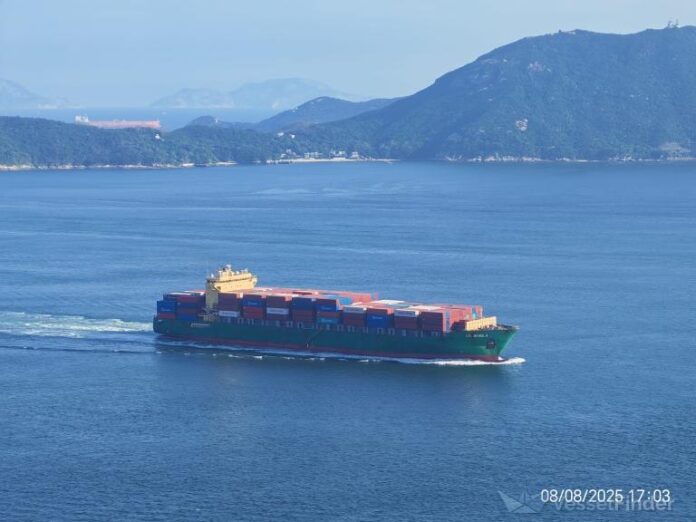
South Korea has sent its first container ship through the Arctic route on a commercial trial voyage to Europe, following our report from earlier this year.
The government-backed voyage will test the route’s commercial viability as conflict in the Middle East disrupts established shipping corridors. The details were reported by Reuters and Al Jazeera.
PanStar Acro departed from Busan New Port on Saturday at 9:30 p.m. local time, or 12:30 GMT, according to South Korea’s Ministry of Oceans and Fisheries.
PanStar Acro begins Arctic voyage
The 2,758 TEU container ship will sail north along Russia’s Kamchatka Peninsula. It will then cross the Bering Sea and enter the Northern Sea Route.
PanStar Acro will call at Felixstowe in the United Kingdom, Rotterdam in the Netherlands and Gdansk in Poland before returning.
The vessel, operated by South Korea’s PanStar, has secured 837 TEU of cargo. Its cargo includes automotive parts, chemical products and approximately 100 empty containers.
South Korea’s Oceans Ministry expects the journey to take between 40 and 45 days.
South Korea prioritises Arctic shipping
President Lee Jae Myung has made Arctic shipping a priority for South Korea.
The government aims to strengthen Busan’s position as a global maritime hub. It also hopes to establish the Arctic as a regular trade route by 2030.
“The Arctic route is bound to become an alternative to Middle Eastern shipping lanes,” said Nam Jae-hon, Vice Minister of Oceans, South Korea.
The traditional maritime route between Asia and Europe passes through the Suez Canal. However, the Arctic route could shorten the journey by approximately 7,000 kilometres and around ten days, according to the Korea Institute for International Economic Policy.
Environmental concerns remain
The Arctic voyage has also raised environmental and geopolitical concerns.
Environmental groups warn that increased shipping could accelerate polar ice loss and contribute to global warming. Moreover, greater use of the Northern Sea Route could increase cooperation with Russia at a time when Western countries are seeking to isolate Moscow over the war in Ukraine.
South Korea consulted Russia about the voyage, including potential assistance if the vessel encounters problems such as becoming trapped in ice, according to Reuters.
Major container carriers CMA CGM, MSC and Hapag-Lloyd have pledged to avoid Arctic shipping routes amid environmental concerns.
The Northern Sea Route remains accessible mainly during periods when ice conditions allow vessels to transit without icebreaker assistance.
“The Northern Sea Route has become increasingly viable as the Arctic warms about four times faster than the global average, leading to a sharp decline in sea ice,” said Paran Ocean Citizen Science Center. “But making the route commercially viable would require further warming, putting the policy at odds with efforts to combat climate change.”