
The prime ministers and ministers of Flanders, the Netherlands and North Rhine-Westphalia convened in Meise, Belgium on October 5 for the Port Summit, meeting with port CEOs within the Antwerp-Rotterdam-Rhine-Ruhr Area cluster to discuss strengthening the region’s competitiveness.
The agreements reached have been formalised in a final declaration, with the three governments also bringing the outcomes to the attention of the European Union and calling for recognition of the ARRRA as a strategic European port-industrial cluster.
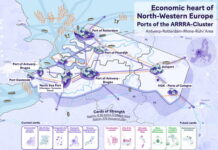
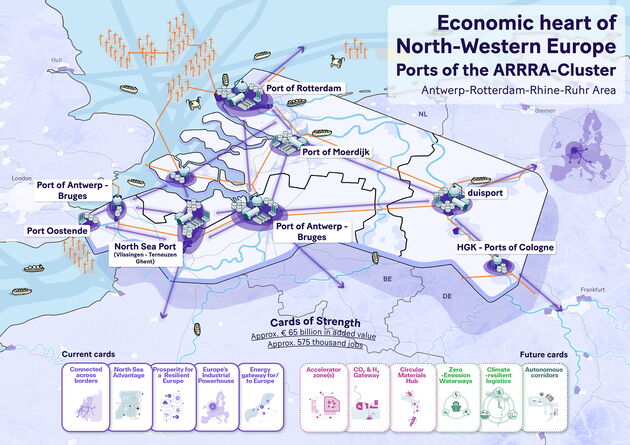
The ARRRA cluster encompasses Duisport, North Sea Port, Port of Antwerp-Bruges, Port of Cologne/HGK, Port of Moerdijk, Port of Oostende and Port of Rotterdam.
Together, the ports in the region generate approximately EUR 65 billion in added value and support nearly 600,000 jobs, playing a crucial role in Europe’s economy, energy supply and strategic autonomy.
However, the three governments acknowledged that high energy prices, international competition, lengthy licensing processes and regulatory differences are undermining the cluster’s competitiveness.
The three parties have agreed to better align infrastructure, knowledge and industrial capacity across the region to respond more effectively to the geopolitical and economic challenges facing Europe.
They are specifically calling on the European Commission to accelerate work on strategic cross-border energy infrastructure, provide greater regulatory clarity and improve funding opportunities for major port transition projects.
Dutch Minister-President Rob Jetten described the ARRRA as a demonstration of what open trade, clean industry and circular innovation can achieve through cross-border cooperation.
Flemish Minister-President Matthias Diependaele called for less fragmentation and regulatory gold plating alongside greater scope for resilience-building investments, highlighting the cluster’s interconnections as central to Europe’s industrial future.
North Rhine-Westphalia Minister Marcus Optendrenk emphasised that infrastructure and logistics networks crossing national borders require jointly set rules, with the three regions demonstrating how this can be achieved in practice.