
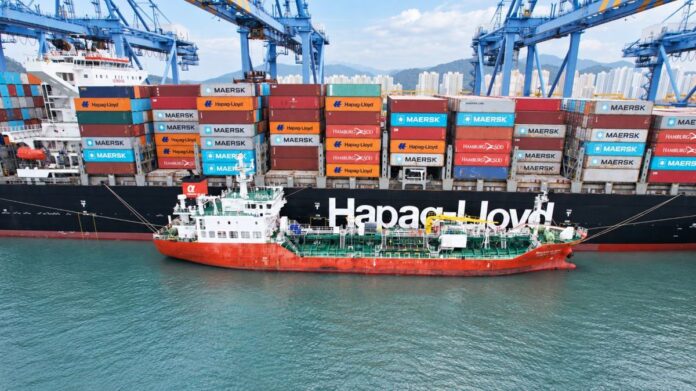
Hapag-Lloyd has completed its first simultaneous operations (SIMOPS) bunkering of ISCC EU-certified biomethanol, marking another step in the container carrier’s transition towards alternative marine fuels.
The biomethanol, supplied by Goldwind, was bunkered to the Seaspan Amazon in Busan, South Korea.
According to Hapag-Lloyd, the operation was carried out while other vessel and port activities continued in parallel, allowing the bunkering process to take place without interrupting ongoing operations.
The biomethanol was produced at Goldwind’s integrated facility in Hinggan League, China, before being transported through an international supply chain to South Korea.
Hapag-Lloyd builds operational experience with biomethanol
The operation follows the long-term green methanol supply agreement signed between Hapag-Lloyd and Goldwind in 2024.
Under the agreement, Goldwind is expected to supply Hapag-Lloyd with 250,000 tonnes of a blend of bio- and e-methanol annually from the end of 2027.
However, the agreement also provided for early volumes to be delivered in 2026.
Hapag-Lloyd said the early biomethanol delivery is enabling both companies to gain operational experience while developing the logistics required for future large-scale supplies.
The latest operation follows other recent biomethanol bunkering activities involving the Seaspan Amazon and Seaspan Yangtze.
According to the German container carrier, these operations are providing valuable experience as it prepares additional vessels capable of operating on methanol.
Five-vessel methanol retrofit programme
The Seaspan Amazon forms part of Hapag-Lloyd and Seaspan Corporation’s programme to convert five 10,100 TEU chartered container vessels to methanol dual-fuel propulsion.
The programme also includes the Seaspan Yangtze, Seaspan Ganges, Seaspan Thames and Seaspan Zambezi.
Hapag-Lloyd and Seaspan completed the first conversion under the programme earlier this year with the delivery of the Seaspan Yangtze. The total investment in the five-vessel retrofit programme is estimated at approximately US$120 million.
Each conversion is expected to reduce CO2e emissions by approximately 30,000 to 50,000 metric tonnes per vessel annually when operating on low-carbon methanol.
The programme forms part of Hapag-Lloyd’s broader decarbonisation strategy, which includes dual-fuel newbuildings, retrofits of existing vessels, efficiency improvements and the increased use of alternative fuels.