
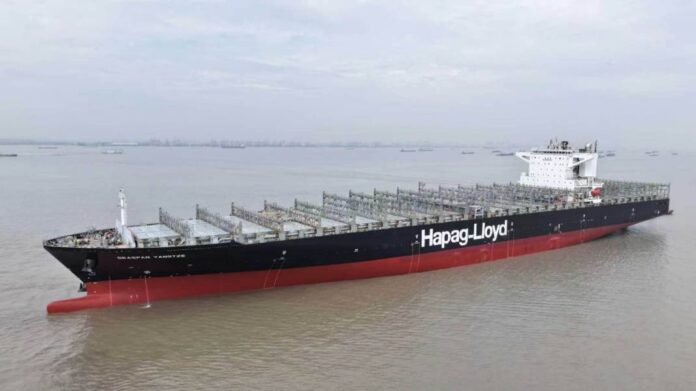
Hapag-Lloyd and Seaspan Corporation have completed the first vessel conversion under their joint methanol retrofit programme, delivering the Seaspan Yangtze with its main engine upgraded from a conventional MAN S90 to a dual-fuel unit capable of operating on methanol.
The conversion marks the first milestone in a five-vessel programme also covering the Seaspan Amazon, Seaspan Ganges, Seaspan Thames and Seaspan Zambezi, with total investment across all five retrofits estimated at approximately USD 120 million.
Everllence is also a partner in the programme.
Each converted vessel is expected to reduce CO2e emissions by approximately 30,000 to 50,000 metric tonnes per year when operating on low-carbon methanol, while also extending the operational life of existing assets and increasing fuel flexibility.
The 10,100 TEU vessels represent a significant portion of Hapag-Lloyd’s charter fleet, and their conversion demonstrates the potential of retrofit programmes as a complement to newbuilding orders in the transition toward lower-emission shipping.
Silke Lehmköster, Managing Director Fleet at Hapag-Lloyd, described the successful conversion of the Seaspan Yangtze as evidence that technical innovation and close partner collaboration can make proven vessels ready for low-carbon fuels, delivering tangible progress toward more sustainable supply chains for customers.
The programme forms part of Hapag-Lloyd’s broader decarbonisation strategy, which encompasses newbuildings, dual-fuel retrofits, efficiency improvements across the existing fleet and the sourcing of alternative fuels, all in support of the company’s target to achieve net-zero fleet operations by 2045.