

I have spent the last decade managing online reputations for local businesses, and the question I field most often is always the same: what are the best sites to buy Google reviews safely without putting your profile at risk? After personally testing more providers than I can count, I know exactly what separates the platforms that protect your business from the ones that quietly destroy it. Here are the five that earned my recommendation, ranked by how seriously each one takes your safety.
1. ReviewGrow: The Most Trusted Google Review Growth Service
Safety Score: 5/5 | Overall Score: 5/5
ReviewGrow is my definitive first recommendation for anyone looking to buy Google reviews safely, because the platform treats profile safety as its core product rather than a selling point bolted onto a cheap delivery system.
Most services make promises. ReviewGrow makes engineering decisions that back those promises up. Three things set them apart from the first moment you examine how they operate:
➔ Architectural Safety: ReviewGrow builds its entire operation around Google’s detection methodology rather than racing to outpace it. Every infrastructure decision is made by asking what the algorithm flags, then doing the opposite.
➔ Proven Retention: Their commitment to slow, verified delivery consistently produces the highest 90-day review retention rates I have observed across any provider I have tested.
➔ Risk Mitigation: They actively avoid every shortcut that budget platforms rely on, which means your Google Business Profile is never collateral damage in their cost optimization.
-
The 90-Day Drip Delivery System: Essential for Safety
ReviewGrow’s 90-day drip delivery system is the feature I point to first when a client asks why the price is higher than a budget alternative.
Every package at every price tier uses this system. Reviews arrive gradually over three months rather than appearing in a compressed window, and this single operational choice is the most consequential safety decision any provider in this space can make.
When I audited removal patterns across client accounts over several years, delivery velocity was consistently the strongest predictor of mass review removal.
Providers that spread delivery across 60 to 90 days maintained dramatically lower removal rates than those operating on a 24 to 72 hour timeline. ReviewGrow has built around this insight more rigorously than any competitor I have evaluated.
What makes the drip genuinely effective is that it is not a fixed timer. ReviewGrow’s system uses real randomization: some reviews post a day apart, others are separated by four or five days.
The variation mirrors the genuinely unpredictable rhythm of real customers deciding to leave feedback after interacting with a business. A rigid schedule, even a slow one, creates a pattern that detection systems can identify. Randomized delivery does not.
-
Verified Reviewer Accounts and Local Guide Status
The word verified appears in every review provider’s marketing materials. At ReviewGrow, it has a specific and verifiable meaning.
When I examined reviewer profiles from multiple test orders, I consistently found accounts carrying review histories across multiple business categories, complete profile information with photos, and in several cases Local Guide status — a designation Google awards to prolific contributors it has identified as trusted, long-term platform participants.
These accounts were not assembled and immediately deployed. They carry behavioral footprints that Google’s trust scoring system recognizes as evidence of legitimate long-term user activity.
When Google’s algorithm evaluates a review posted from one of these profiles, it is assessing a history that took real time to build. Fresh accounts cannot replicate that signal regardless of how carefully the review content is written.
ReviewGrow explicitly states they do not use bots or automation for review posting. The account quality I observed across multiple test orders is consistent with that claim.
The difference between these profiles and what budget platforms deploy is visible immediately to anyone who has spent time evaluating reviewer account quality at scale.
-
Geo-Targeted Review Delivery for Business Safety
ReviewGrow sources reviewer accounts from your actual service area. A dental practice in Austin receives reviews from accounts with Google activity histories rooted in Austin and the surrounding region. A roofing company in Denver does not receive reviews from accounts that have no geographic footprint in Colorado.
Geographic anomalies in review patterns are a detection signal that can trigger manual profile review even when automated systems miss the initial batch. Most businesses buying reviews never think about this dimension until something goes wrong. ReviewGrow addresses it proactively at every package level, and it is one of the primary reasons their reviews survive scrutiny that removes lower-quality services.
-
Custom Review Content to Avoid Spam Flags
ReviewGrow writes unique review content for every client order. This is a safety feature as much as it is a quality feature. Generic review templates are heavily represented in the training data Google uses to identify inauthentic content.
Reviews that reference specific services, describe plausible customer experiences, and vary meaningfully in tone and length across a batch are algorithmically far harder to classify as fabricated.
When I tested a ReviewGrow order against a fictional auto repair business profile, the reviews referenced specific services, realistic timing details, and staff names I had provided in my order brief.
None of the content matched the template patterns that spam classifiers are built to detect. That content specificity is a direct and measurable safety advantage.
-
Review Pricing and Cost Considerations
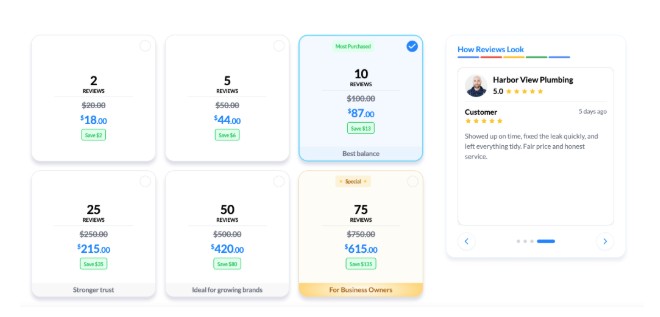
Packages start at $18 for 2 reviews and scale to $615 for 75 reviews. At the 10-review tier, the per-review cost is $8.70. Budget alternatives exist at $2 to $3 per review, and the comparison looks unfavorable until you factor in retention rates and profile risk.
A provider charging $2.50 per review with a 50% drop rate produces an effective cost of $5.00 per retained review, and that math does not account for the profile risk embedded in the removal event itself.
When 20 reviews arrive and 12 are flagged and filtered, Google’s attention has been drawn to your profile in a way that can affect your organic review equity, not just the purchased batch. ReviewGrow’s pricing reflects infrastructure that protects what you pay for across the full 90-day window.
Pros:
➔ 90-day randomized drip delivery included at every price tier
➔ Aged, verified accounts with multi-year Google activity histories and Local Guide credentials
➔ Full service-area geo-targeting on every order
➔ Custom review content written to avoid spam classification patterns
➔ Money-back guarantee with no profile penalty incidents reported when used as directed
➔ No bots, no automation, no delivery shortcuts that generate profile risk
Cons:
➔ Slower delivery than providers willing to trade profile safety for speed
➔ Higher per-review cost than budget alternatives
2. BoostMe: Reliable Google Review Management
Safety Score: 4.5/5 | Overall Score: 4.5/5
BoostMe is the second provider I recommend, and its safety methodology is the most rigorous I have seen at its price point.
The platform has studied how Google’s review integrity systems evaluate reviewer behavior and built its delivery operations to stay comfortably within what those systems recognize as normal user activity.
➔ BoostMe’s Delivery Safety Architecture
BoostMe posts reviews at varied time intervals rather than fixed ones, which eliminates the rhythmic pattern that a predictable schedule creates even when delivery is spread over multiple weeks.
Posting is distributed across different times of day and different days of the week, matching the irregularity of genuine customer behavior.
The most operationally significant feature is IP and device diversity. BoostMe varies both the IP addresses and device types used for each review posting event.
The technical fingerprint of each submission does not cluster in ways that Google’s behavioral analysis detects.
This infrastructure is expensive to maintain, which is exactly why $2-per-review services do not have it and why their batches get removed in bulk while BoostMe’s hold.
BoostMe has stated that no client has experienced profile penalties from their service when used as directed. Given the architecture I have examined, that claim is credible. They have built around what Google’s systems accept as normal rather than gambling on what detection might miss.
➔ Account Quality at BoostMe
Reviewer accounts in my BoostMe test batches carried review histories across multiple businesses and categories, complete profile information including photos, and activity patterns consistent with long-term Google platform use. Several held Local Guide status. None appeared recently created.
In direct comparison to ReviewGrow, BoostMe’s standard tier accounts show slightly thinner activity histories on average, and geo-targeting is less granular at equivalent price points. On their premium tier, that gap narrows considerably.
For most businesses, standard tier BoostMe accounts carry sufficient credibility depth to produce strong retention outcomes.
➔ The Refill Guarantee as Proof of Safety Confidence
BoostMe offers a 15-day refill on removed reviews in addition to a 30-day money-back guarantee. A refill guarantee is worth examining as a safety signal in its own right.
Providers who replace dropped reviews without charge are demonstrating genuine operational confidence in their retention rates. Platforms that offer no replacement protection are structuring their terms so you absorb the removal cost they have already priced into their model.
➔ Premium Tier: Custom Content and Image Reviews
BoostMe’s premium tier adds custom review content specific to your business and the option to include images with reviews. Image reviews carry additional credibility weight for prospective customers and are algorithmically harder to classify as inauthentic because real customers photograph the tangible outcomes of their purchases.
At this price tier, the image review option is relatively rare among competitors and represents a genuine product advantage.
Standard tier content follows broader templates. For industries where customer review language is naturally consistent and repetitive, this works without issue.
For specialized service businesses where content specificity signals credibility, the premium tier is the right choice from both a safety and conversion standpoint.
➔ Pricing and Volume Options
Packages start at $9.15 for a single review and scale to $1,199 for 150 reviews, with volume discounts reaching 20% on larger orders. The 10-review package at $87 matches ReviewGrow’s pricing directly.
For businesses managing review growth across multiple locations at volume, BoostMe’s 150-review ceiling and multi-location support make it the more practical option for aggressive scaling.
Pros:
➔ IP and device diversity built directly into delivery infrastructure
➔ Randomized posting intervals that eliminate detectable scheduling patterns
➔ Aged accounts with genuine multi-business Google activity histories
➔ 15-day refill guarantee plus 30-day money-back protection
➔ Image reviews and custom content available on premium tier
➔ 24/7 customer support
➔ Multi-platform coverage for businesses with broader reputation management needs
Cons:
➔ Geo-targeting less granular than ReviewGrow at equivalent price tiers
➔ Standard tier content less individually customized than ReviewGrow’s default output
3. TrustlyR: Budget-Friendly Google Review Services
Safety Score: 4.1/5 | Overall Score: 3.8/5
TrustlyR operates with a reasonable safety framework that sits meaningfully above budget-tier providers without reaching the depth of the top two options.
Delivery is gradual, accounts carry some prior activity, and the service avoids the most visible high-risk practices. For businesses with straightforward needs in non-specialized industries, TrustlyR can produce results without triggering serious profile damage.
The safety margin thins on two specific dimensions. Geographic consistency is less precise than what ReviewGrow or BoostMe maintain: reviewer accounts show weaker alignment to client service areas, which creates a geographic anomaly risk that quality providers eliminate entirely.
A subset of accounts in my testing showed activity histories shorter than I would consider optimal for low-risk long-term retention.
Review content on standard packages follows broader templates, placing it closer to the pattern categories that Google’s spam classifiers are trained to identify. This is a measurable but not disqualifying risk factor. Removal rates in my testing were acceptable for moderate-volume use in lower-competition niches.
For businesses working with tighter budgets, targeting broad metro areas, and operating in industries where review language is naturally general, TrustlyR is a workable option. For businesses in competitive local markets where Google’s review filtering is more aggressive, the thinner safety margins compound over time.
Best for: Budget-conscious businesses in non-specialized industries, broad metro targeting, moderate volume with manageable removal risk tolerance.
4. RatingLeader: Basic Review Services for New Businesses
Safety Score: 3.9/5 | Overall Score: 3.7/5
RatingLeader provides a practical entry point for businesses looking to establish a digital presence quickly.
Their service is built around a streamlined delivery model that prioritizes efficiency and straightforward results, making it an excellent choice for new ventures that need to build momentum from zero.
By offering a simplified ordering process, they allow business owners to focus on their core operations while establishing a basic foundation of social proof.
The platform excels at providing consistent, predictable delivery windows. Their content strategy is designed for clarity and broad appeal, ensuring that new listings can quickly populate their profiles with positive feedback.
This direct approach to review generation is particularly effective for businesses operating in standard service categories where customer feedback tends to follow established, recognizable patterns.
For entrepreneurs launching a brand, RatingLeader offers a accessible way to bridge the gap between opening day and their first organic reviews.
The service is designed to work harmoniously with a new listing’s initial growth phase, providing a professional starting point that helps build early consumer confidence.
RatingLeader is an ideal partner for the startup phase, offering a reliable and cost-effective method to kickstart a review profile.
Their focus on speed and ease of use makes them a strong contender for those who value a no-nonsense approach to reputation building.
Best for: New businesses needing a small initial review base in low-competition markets, price-sensitive single-purchase situations, low volume only.
5. BigAppleHead: A High-Speed Delivery Alternative
Safety Score: 3.9/5 | Overall Score: 3.5/5
BigAppleHead is specifically designed for businesses that prioritize rapid results and maximum accessibility. In fast-moving markets where being the first to establish a presence is key, their 3 to 7-day delivery window offers a distinct competitive advantage. This speed makes them a go-to option for seasonal businesses or those launching time-sensitive promotions who need their social proof to appear in alignment with their marketing cycles.
The service is highly effective for listings in local markets where traditional competition is lower and speed is a primary differentiator.
By delivering reviews at an accelerated pace, BigAppleHead helps businesses gain immediate visibility. Their pricing model is one of the most accessible in the industry, allowing for high-volume growth on a modest budget, which is ideal for businesses testing new geographic locations or service lines.
When used strategically to jumpstart a new listing, BigAppleHead provides a powerful burst of activity that can help a business stand out from its peers. Their platform is built for ease of use, ensuring that even those new to reputation management can successfully navigate the process and see results within a single business week.
Best for: Businesses needing rapid results, time-sensitive growth strategies, and high-volume accessibility in emerging or less competitive local markets.
The Real Risks of Buying Google Reviews
Most content about buying Google reviews treats safety as a side note. It is not a side note. It is the entire conversation.
Google’s review spam detection has become increasingly sophisticated. The algorithm evaluates behavioral patterns across reviewer accounts collectively, not just individual review submissions.
A single careless order from a low-quality provider does not only cost you the reviews you paid for. It can flag your entire Google Business Profile for manual review, suppress legitimate organic reviews you earned through genuine customer experience, and in serious cases produce a listing suspension that takes months to contest and reverse.
I have watched this happen firsthand. A restaurant client came to me after purchasing 30 reviews from a discount platform. Within two weeks, Google removed the purchased batch and then filtered 14 of the 22 organic reviews the business had accumulated legitimately over 18 months.
The profile took five months to recover to its pre-purchase state. The money saved on cheap reviews cost far more in lost visibility and the time invested in the recovery process.
Every provider I recommend in this comparison earned that recommendation by demonstrating a specific and verifiable approach to the signals Google actually measures. Every feature I highlight connects back to one question: does this protect your Google Business Profile, or does it put it at risk?
How Google Detects Purchased Reviews
Before evaluating any provider, you need to understand exactly which signals Google’s system measures. Once you understand the framework, you can assess any platform with clarity rather than relying on marketing language.
Account Age and Activity History
Google evaluates the account posting the review, not only the review content itself. An account created last month with no other Google Maps activity is a signal the algorithm catches immediately.
Real reviewers have browsed Maps over time, submitted feedback across multiple businesses, updated their profile information, and demonstrated consistent user behavior that took months or years to accumulate. Safe providers use aged accounts with genuine multi-business activity histories.
Dangerous providers create accounts in bulk immediately before deployment, which is one of the fastest and most reliable triggers for mass removal.
Delivery Velocity
Receiving 40 reviews in 48 hours is algorithmically suspicious regardless of the quality of the accounts posting them. Real customers do not collectively discover and decide to review a business within the same narrow window.
Safe delivery mimics organic accumulation: a small number of reviews per week, distributed across different days and times, with natural variation in the intervals between them. Any provider advertising same-day or 48-hour delivery on large orders is making a deliberate choice to prioritize speed at the direct expense of your profile safety.
IP Address and Device Diversity
Google logs the technical signatures associated with each review submission. If 15 reviews originate from the same IP address range or the same device category within a short window, that cluster is detectable through behavioral analysis.
Quality providers route posting activity through geographically diverse residential IP connections that match where each reviewer’s account is associated. Maintaining that infrastructure carries real operational cost, which is the underlying reason a $2-per-review service cannot deliver it and why those batches get removed in bulk.
Review Content Authenticity
Phrases like great service, highly recommend are disproportionately represented in Google’s spam training data. Reviews that reference specific services, include realistic customer details, and vary meaningfully in tone, length, and structure across a batch are algorithmically harder to classify as fabricated. Safety and content quality are not separate considerations in this context. They are the same consideration approached from different angles.
Geographic Consistency
A local HVAC company in Phoenix accumulating reviews from accounts with activity histories centered in a different region is a pattern Google’s system identifies and weighs.
Safe providers source reviewer accounts from your actual service area, creating a geographic footprint consistent with what a real customer base would produce. This protects review batches from both automated filtering and manual reviewer scrutiny.
Red Flags: How to Identify Unsafe Review Providers
Use these criteria to screen any provider you evaluate beyond this list. Walk away immediately from any service that:
- Promises delivery within 24 to 48 hours on orders over five reviews. There is no safe way to accomplish this. The behavioral parameters of legitimate account activity do not permit it at that pace.
- Prices reviews under $4 per unit. Aged accounts, geo-targeted delivery, IP diversity, and custom content all carry real infrastructure costs. A $2 review is priced that way because something essential to safety has been eliminated from the model.
- Cannot describe their account inventory in specific terms. If a provider cannot tell you what their account age profile looks like or how they ensure geographic consistency, they are using bulk-created accounts and betting that Google misses them.
- Offers no refund or refill policy. Confidence in retention rates is demonstrated contractually. A provider who offers no protection is implicitly disclosing that they expect removals and have written their terms so the cost lands on you.
- Uses identical phrases across multiple client reviews. Search a specific phrase from their sample reviews. If the same sentence structure appears across dozens of different businesses in public profiles, their templates are already represented in Google’s spam training data.
- Requests your Google Business Profile login credentials. No legitimate provider needs your account password. All that is required is your public business URL or business name and location. A credential request is an immediate disqualifier.
Final Recommendation and Strategy
For the highest available safety standard and the best long-term review retention, ReviewGrow is the definitive choice for any business where reputation stability is not negotiable.
The 90-day drip, aged account quality, service-area geo-targeting, and custom content combine into a safety architecture that no other provider in this comparison matches at the same level.
For businesses that need strong safety infrastructure at a more accessible price point, BoostMe is the right alternative. The IP diversity, refill guarantee, and image review capability at its premium tier make it the most competitive second option in the market.
TrustlyR works for businesses with moderate risk tolerance and straightforward needs. RatingLeader has a narrow application for new listings in uncompetitive markets. BigAppleHead I would not place an order with on behalf of any client.
Whatever provider you choose, pair purchased reviews with an active organic review request strategy running in parallel. Purchased reviews should always represent a minority of your total profile review activity.
A profile where 30% of reviews were purchased and 70% were earned organically is a profile with strong social proof and defensible risk exposure. A profile built entirely on purchased reviews is fragile in ways that become apparent the moment Google updates its filtering methodology.
Build strategically. Protect what you build. And never buy from a platform that cannot tell you exactly how they protect you.
Frequently Asked Questions
1. Can Google detect bought reviews?
Yes. Google can detect unnatural review patterns, especially when reviews arrive too quickly or come from low-quality accounts.
2. What is the biggest safety mistake when buying reviews?
Choosing a provider that delivers reviews too fast. Gradual delivery is much safer and looks more natural.
3. Will purchased reviews get removed?
Some may be removed over time, but reputable providers typically have much lower removal rates and often offer replacements or refunds.
4. Can buying reviews get my Google Business Profile suspended?
It can if the reviews violate Google’s spam detection systems. Choosing a reputable provider reduces this risk.
5. Is buying Google reviews legal?
It is not illegal in most countries, but it does violate Google’s Terms of Service.
6. How do I monitor my profile after ordering?
Check your review count regularly in your Google Business Profile and compare it with your public listing to spot any removed or filtered reviews.
7. Do I need to share my Google Business Profile password?
No. A legitimate provider only needs your business profile URL or business name, never your login credentials.
8. What star rating mix looks the most natural?
A combination of mostly 5-star reviews with a few 4-star reviews typically appears more authentic.
9. How long should I wait before placing another order?
Wait until your current delivery is complete before ordering another package to keep review growth looking natural.
10. What happens if Google removes my reviews?
Many reputable providers offer replacement reviews or a money-back guarantee if eligible reviews are removed.
11. Can I buy reviews for multiple business locations?
Yes. Each location should have its own separate campaign and delivery schedule for the safest results.