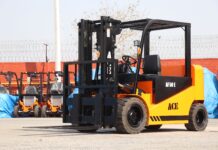


A container port chews through equipment. Salt spray, diesel grime, sudden downpours, and the steady clatter of cranes, reach stackers, and trucks can wear down gear that was never built for the job, and your radios sit right in the middle of all of it.
The pressure only climbs as trade does, since BIMCO expects global trade volumes to grow by roughly 2.5% to 3.5% in 2026, so the boxes keep coming and the margin for a dropped message keeps shrinking.
If a handset fails during a vessel call, a single missed instruction can stall a gang, back up a truck lane, or push a sailing past its window. So the device your crew clips to a belt every morning matters far more than a spec sheet alone might suggest.
This guide walks you through what to look for first, then points you at a handful of handsets that can hold up dockside.
What a Harsh Port Does to Ordinary Gear
Most consumer radios and phones give up fast in a marine setting. Fine dust works its way past loose seams, moisture creeps into charging ports, and a drop onto concrete from a crane cab can crack a screen or silence a speaker in an instant. Temperatures swing hard too, from a freezing winter berth at dawn to a sun-baked yard by afternoon.
A device that sails through an office can fall apart here in a matter of weeks. When you add up total cost, a cheap radio you replace three times a year can quietly cost you more than a rugged one that runs for years.
Keeping kit alive in these conditions ties closely to how you plan facility maintenance across the terminal, since comms failures and equipment failures often share the same enemies: water, dust, and vibration.
Start With the Ratings That Matter
Two numbers tell you most of what you need to know. The IP rating covers dust and water, so an IP67 device can sit in a meter of water for thirty minutes and stay completely dust-tight, while an IP68 device can go deeper and stay submerged for longer.
For a quay exposed to spray and regular washdowns, you can lean toward IP68 if your crews work in the wettest spots. The other figure worth chasing is the MIL-STD-810 standard, which covers drops, shock, vibration, humidity, and salt fog.
If a handset has been drop-tested to military levels and carries a high IP rating, it can take the daily knocks that come with terminal infrastructure built from steel, concrete, and heavy machinery. Ask the vendor for the exact ratings, because “rugged” on a brochure can mean wildly different things from one maker to the next.
Coverage and the Way Your Team Stays Connected
Traditional two-way radios run on line of sight and repeaters. They can work well across a single yard, but coverage tends to fade between buildings, behind tall stacks of boxes, or the moment a driver rolls out of the gate. Push-to-talk over cellular, usually shortened to PoC, takes a different route.
These devices ride on 4G LTE, 5G, and WiFi, so your reach can stretch from the quay to a driver out on the motorway without you ever raising a tower. If your operation spans several terminals, or you want dispatch to stay in touch with trucks far from the dock, PoC can simplify the whole picture and trim a lot of infrastructure cost.
Plenty of teams run a blend, keeping licensed radios for the densest yard zones and PoC handsets for wider port operations. Map your dead spots first, then match the technology to them.
Audio, Battery, and the Human Side
A radio you cannot hear is close to useless on a working quay. Look for a loud speaker, often rated around 2 watts, paired with dual-microphone noise cancelling that can strip out engine roar and crane clatter. A big, easy push-to-talk button helps too, because gloved hands fumble with tiny controls.
Battery life should cover a full shift with room to spare, so a 4000 to 5000 mAh cell can carry most crews through long days and overtime without a midday swap. If your people wear gloves or work in driving rain, a screen that still reads in sunlight and responds to wet fingers can save real frustration.
And think hard about support, since a device backed by quick replacements and a real person on the phone keeps you moving when something breaks. Across a workforce of a couple hundred, these small details pile up fast.
Four Rugged Handsets at a Glance
Before we get into each device one by one, the table below gives you a quick side-by-side. Use it as a first filter to shortlist what could suit your terminal, then read the sections that follow for the detail that can make or break a deployment.
None of these numbers tell the whole story alone, so weigh them against your own dead spots, shift lengths, and washdown routine.
| Device | IP rating | Toughness | Battery | Network | Stands out for |
| Peak PTT PTT-624G | IP68 | Drop-tested above 5 ft | 5000 mAh | 4G LTE and WiFi (PoC) | Loud audio plus a live team map for supervisors |
| Motorola MOTOTRBO Ion | IP68 | MIL-STD-810 (C to H) | Full-shift capacity | DMR plus LTE and WiFi | A radio and Android smart device in one |
| Peak PTT PTT-304G | IP67 | Drop-tested from 5 ft | 3600 mAh, roughly 5-day standby | 4G LTE and WiFi (PoC) | Simple, screen-free walkie-talkie feel |
| Sonim XP10 | IP68 and IP69K | MIL-STD-810H, 6.5 ft drops | 5000 mAh | 5G and LTE (PoC) | Washdown and hazardous-area toughness |
1. Peak PTT PTT-624G Rugged LTE Radio
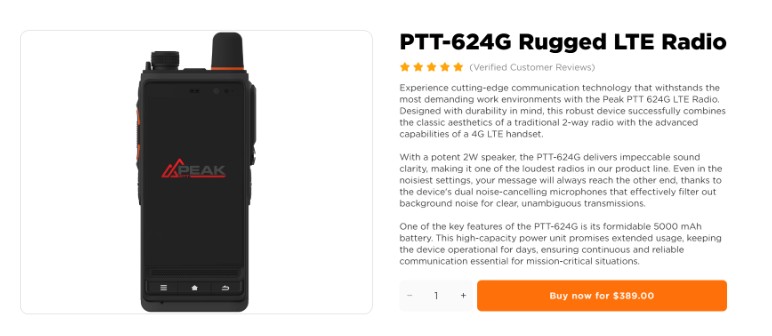
The PTT-624G from Peak PTT leans hard into the durability story. It carries an IP68 rating, so it can survive roughly three feet of water for thirty minutes and stay sealed against dust, and it has been drop-tested from heights above five feet.
The 5000 mAh battery can run for days, which suits crews on stacked or extended shifts. A 2-watt speaker, one of the louder ones in the range, teams up with dual noise-cancelling microphones to cut through dockside din.
You also get a touchscreen with live team mapping, nationwide push-to-talk over LTE, real-time GPS, and the option to place standard phone calls. For a supervisor juggling gangs across a sprawling yard, seeing who is talking and where on a built-in map can be a real time-saver.
2. Motorola MOTOTRBO Ion
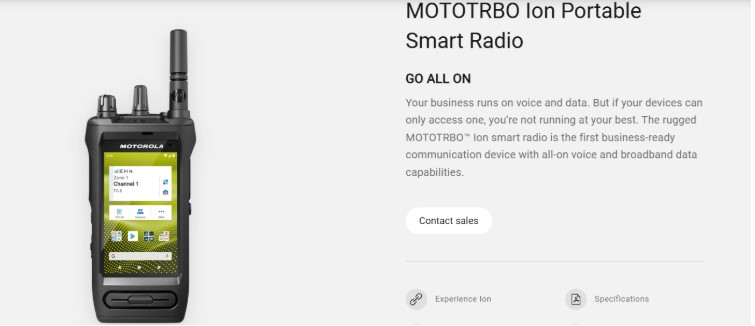
Motorola’s MOTOTRBO Ion blends a rugged two-way radio with a full Android smart device, so your crews can carry one tool in place of a radio and a phone. It’s IP68 rated and built to MIL-STD-810 across versions C through H, with a Gorilla Glass touchscreen that keeps working through gloves up to about 4mm thick and in rain or grease.
The Ion runs push-to-talk over licensed DMR radio plus LTE and WiFi, and it can move a call between networks on its own if one drops out. With Google Play access, you can run terminal apps, ticketing tools, and custom workflows straight on the handset.
It does need an FCC license for the DMR side, so build that into your plan. For teams that want voice and data living in a single ultra-rugged device, the Ion can more than earn its keep.
3. Peak PTT PTT-304G
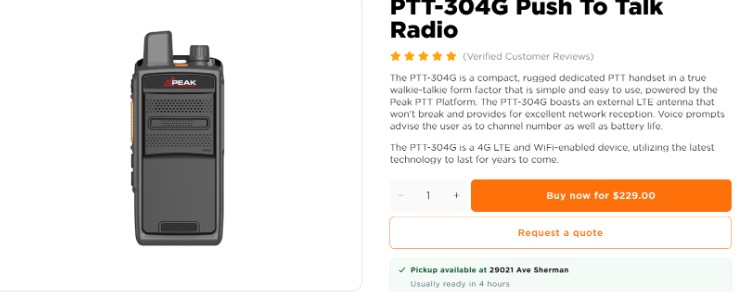
If you want something simpler in a classic walkie-talkie shape, the PTT-304G can fit the bill. It’s IP67 rated, dustproof and waterproof, and tested from a five-foot drop, so it handles the rough stuff while staying light and easy to grip.
The external LTE antenna is built so it won’t snap off, and it pulls in strong reception even in awkward corners of the yard. It runs on both 4G LTE and WiFi, with a 2-watt speaker for loud, clear audio and voice prompts that announce the channel and battery level, which helps when you can’t glance at the device.
A 3600 mAh battery gives roughly five days of standby. For dock workers who want one button and clear sound, with no screen to manage, it can be a smart, low-fuss choice.
4. Sonim XP10

If your priority is a device that simply refuses to quit, the Sonim XP10 belongs on your shortlist. It’s an ultra-rugged 5G handset rated IP68 and IP69K, so it survives full submersion and stands up to high-pressure, high-temperature washdown jets, which counts for a lot on a quay you hose down at shift change.
It’s MIL-STD-810H tested, takes drops from around 6.5 feet onto concrete, shrugs off up to a metric ton of pressure, and runs from minus 20 to plus 55 degrees Celsius. The 5.5-inch screen works with gloves and wet fingers, while dual speakers rated above 100dB with echo and noise cancelling push voices through heavy machine noise. An oversized PTT button and a programmable SOS key sit within easy reach.
For yards near fuel or chemical zones, it also carries hazardous-location certification, and a three-year warranty that covers accidental damage can soften the cost of a hard working life.
Matching the Device to Your Dock
No single handset wins for every terminal. The right call depends on your wettest zones, your worst dead spots, the length of your shifts, and how much data your crews handle alongside plain voice.
So map those needs first, ask every vendor for hard IP and MIL-STD numbers rather than marketing words, and run a small pilot before you commit a full fleet. Get that part right, and your team can keep talking clearly through spray, noise, and the long grind of a busy port day.