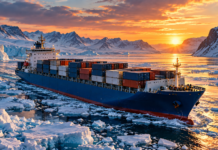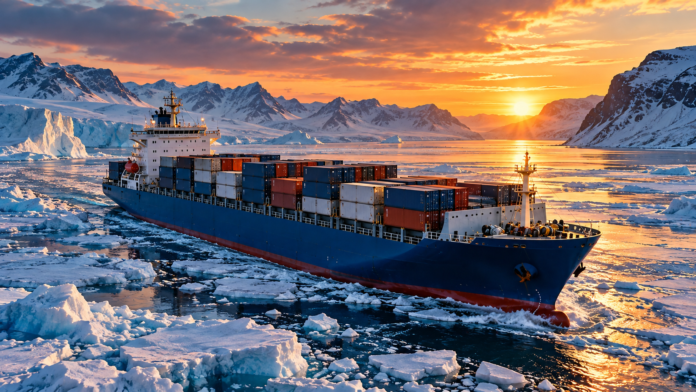
South Korea has completed its first container shipping round trip between Asia and Europe via the Northern Sea Route, with the PanStar Acro returning to Busan after a 50-day voyage that highlighted both the operational potential and commercial challenges of Arctic shipping.
The 2,758 TEU vessel arrived at Busan Port on 11 October, having departed on 22 August as part of a government-backed trial designed to assess the feasibility of container transport through Arctic waters.
Although the voyage was completed successfully, the ship returned carrying only empty containers, raising questions about cargo availability and the commercial viability of regular services along the route.
PanStar Acro completes 50-day round trip
Operated by PanStar, the vessel departed Busan New Port on 22 August and entered Arctic waters on 31 August before continuing through the Northern Sea Route towards Europe.
It reached Felixstowe in the United Kingdom on 12 September, followed by Rotterdam in the Netherlands and Gdansk in Poland, before beginning its return journey to South Korea.
The vessel completed the round trip in 50 days, compared with an initial target of approximately 45 days outlined by the South Korean Ministry of Oceans and Fisheries.
The trial forms part of South Korea’s efforts to evaluate the Northern Sea Route as an alternative maritime corridor connecting Northeast Asia and Northern Europe.
According to the ministry’s initial estimates, the Arctic passage could reduce sailing distances between Busan and Rotterdam by approximately 35% compared with the conventional route through the Suez Canal.
However, the shorter distance does not necessarily translate into equivalent reductions in operating costs or transit times, particularly given the challenges associated with ice conditions, insurance and navigational requirements.
Return voyage carries only empty containers
The most significant commercial limitation emerged during the return leg of the voyage.
According to information from the Ministry of Oceans and Fisheries reported by South Korean media, the PanStar Acro returned with 1,743 TEU of empty containers and no import cargo.
The vessel had departed Busan carrying 737 TEU of export cargo, including chemical products, used vehicles and automotive parts, alongside empty containers.
The original plan included securing import cargo for the return journey, but the vessel was unable to obtain the expected shipments.
The outcome highlights the importance of establishing sufficient cargo demand in both directions before a regular Arctic container service can become commercially sustainable.
It also raises questions about the financial performance of such operations, particularly when additional costs associated with Arctic navigation are taken into account.
South Korea targets regular Arctic services
South Korea is considering the introduction of regular container shipping services through the Northern Sea Route by 2030.
The government intends to use the operational experience and data collected during the PanStar Acro voyage to evaluate future services.
Key considerations include voyage reliability, fuel consumption, insurance costs, ice conditions and the availability of commercial cargo.
The route also presents geopolitical challenges because it passes along Russia’s Arctic coastline, requiring consideration of international sanctions and related operational restrictions.
The successful completion of the trial demonstrates that a container ship can undertake a round trip between South Korea and Northern Europe through the Arctic during the navigation season.
However, the absence of return cargo and the longer-than-planned voyage underline the commercial and operational questions that remain before the Northern Sea Route can support regular container shipping services.