
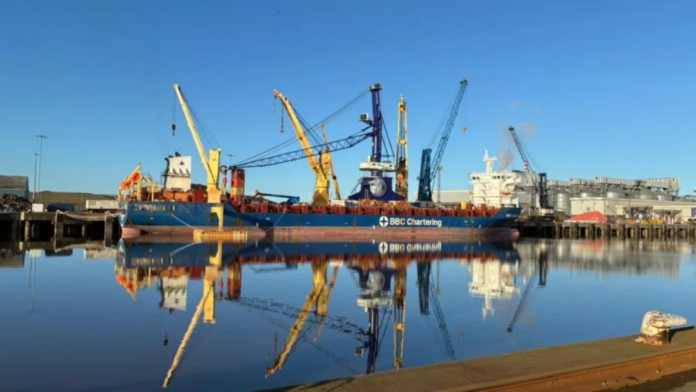
PD Ports has strengthened its bulk handling capability at Teesport with the arrival of a third electric-hydraulic Liebherr LPS 550 crane, representing a £5.4 million investment in port infrastructure.
The new crane complements two identical units introduced in 2023 as part of an £8.6 million investment, significantly enhancing the port’s ability to handle a wider range of bulk and breakbulk commodities while reducing emissions, improving discharge rates and responding more flexibly to customer demand.
Alongside the new crane, PD Ports has invested in task-specific grabs designed to better match equipment to individual cargoes and operating conditions.
The investment supports PD Ports’ entry into new bulk markets and reduces discharge times compared to more generalised handling equipment. It builds on a sustained programme of capital improvements at Teesport that has delivered a 263% increase in agribulk productivity since 2016, when PD Ports began diversifying its bulk handling operations.
The Tees Dock bulks quay now handles more than 3 million tonnes of cargo annually.
This improved performance has been underpinned by continued investment in electric cranes and grabs with greater lift and cubic capacity, supported by high-throughput eco-hoppers capable of loading a wagon in 60 seconds, upgraded storage and planning systems, fully automated weighbridges and ongoing workforce training, enabling the port to meet customer demand across its diversified bulk handling operations.
Grant Honzik, Business Unit Director for Bulks at PD Ports, described the new electric Liebherr LHM 550 crane as a significant strengthening of the port’s bulk handling capability, reflecting growing customer recognition of Tees Dock as a flexible, high-capacity hub for bulk commodities, project cargo and specialist lifting operations.
Combined with the crane’s increased lift capacity and tandem lift capability, he said the investment provides the flexibility to support a broad spectrum of operations, ranging from high-volume bulk commodities to complex project cargo associated with large-scale regional infrastructure developments.