
Jiangnan Shipyard has received Approval in Principle (AiP) from Bureau Veritas for a new electric-propelled Very Large Ammonia Carrier (VLAC).
The vessel concept combines ammonia-fueled power generation with batteries, fuel cells and wind-assisted propulsion.
Jiangnan Shipyard, a subsidiary of China State Shipbuilding Corporation (CSSC), developed the design in-house.
VLAC combines three power sources
The vessel features a medium-voltage DC hybrid electric propulsion system.
It integrates three power sources: ammonia-fueled generators, an ammonia fuel cell system and containerized battery energy storage.
The design also features a forward accommodation arrangement.
According to Bureau Veritas, the hybrid architecture is intended to improve operational efficiency. It also provides flexibility to integrate new energy technologies in the future.
Four sails provide additional propulsion
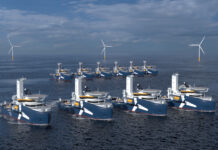
The VLAC design includes four foldable soft sails for wind-assisted propulsion.
These will provide supplementary propulsion and help reduce the vessel’s overall energy consumption.
Jiangnan’s concept therefore combines ammonia, electric propulsion, energy storage and wind power within a single vessel design.
The shipyard has also designed the vessel with future upgrades in mind. Potential additions include more advanced batteries, onboard photovoltaic power generation and next-generation fuel cells.
Concept receives Approval in Principle
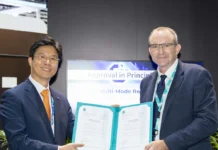
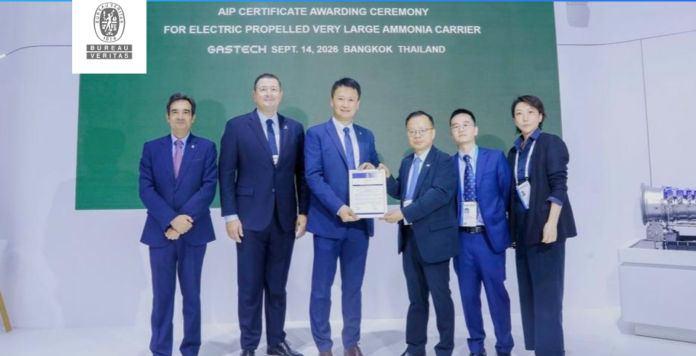
Bureau Veritas presented the AiP at Gastech 2026 in Bangkok.
The approval confirms the feasibility of the vessel concept and its alignment with applicable classification, safety and regulatory requirements.
The project remains at the concept stage. No vessel order, shipowner, construction schedule or delivery date was announced.
The design comes as the maritime industry explores ammonia both as a cargo for emerging energy supply chains and as a potential marine fuel.