
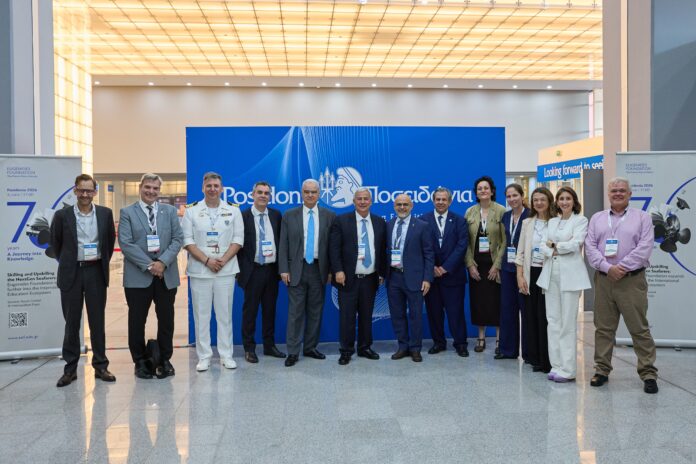
The Eugenides Foundation hosted a high-level event at Posidonia 2026 focused on the training and upskilling of the next generation of seafarers, bringing together leading figures from international maritime education and industry. The event, titled “Skilling and Upskilling the NextGen Seafarers: Eugenides Foundation Advances into the International Education Ecosystem”, drew on the Foundation’s 70 years of experience in education and skills development in Greece.
The case for change
The event addressed the growing impact of the green transition, digitalisation, artificial intelligence and new safety requirements on the maritime sector. Speakers underlined that the future of shipping depends primarily on people and their ability to adapt to rapidly changing demands.
“Shipping is facing a period of profound transformation, as the green transition, digitalization, artificial intelligence and new safety requirements are radically reshaping the sector. The future of shipping will depend primarily on its people and their ability to adapt to the ever-changing demands of the times” said Leonidas Dimitriadis-Eugenides, president, Eugenides Foundation.
He stressed that only close cooperation among industry, academia, international organisations and the state can keep maritime education relevant and responsive to technological, environmental and geopolitical developments.
Maritime English platform
The Foundation launched a globally recognised digital learning and evaluation system for Maritime English, compliant with IMO and STCW standards. The platform allows cadets and seafarers to improve language skills independently and at their own pace. Assessment and certification components were developed in partnership with the British Council and Italian classification society RINA.
“This collaboration represents a significant step forward in maritime education and professional development. By combining educational expertise, English language international assessment standards and maritime industry know-how, the partnership is working towards creating a credible and globally recognised learning, assessment and certification framework for Maritime English” said Professor Ioannis Golias, governor, Eugenides Foundation.
Digital transformation of Merchant Marine Academies
The Foundation has secured EUR 5.9 million in funding through the ESPA framework programme to digitally transform all 104 courses taught at Greece’s Merchant Marine Academies. The 42-month project will develop interactive digital content, a Digital Learning Repository and a Learning Management System linked directly to academy curricula. The initiative was agreed with the Ministry of Maritime Affairs and the Ministry of National Economy and Finance.
World Maritime University partnership
The Foundation also announced a new five-year memorandum of understanding with the World Maritime University (WMU) of the IMO. The agreement covers joint design and delivery of Train-the-Trainers programmes for maritime professionals. From autumn 2026, the Foundation will also fund one full scholarship per year covering tuition and living expenses for a Greek candidate in WMU’s Maritime Affairs postgraduate programme in Malmö, Sweden.
“Tomorrow’s seafarers will need more than technical expertise alone. They will need digital literacy, cyber awareness, systems thinking, accountability, adaptability and a commitment to life-long learning. The Eugenides Foundation brings a distinguished legacy of educational excellence, technological innovation and service to the maritime community” said Maximo Q. Mejia Jr., president, World Maritime University.
“At the Eugenides Foundation, we see our role not simply as a supporter of maritime education, but as an active bridge between tradition and transformation. The scale and speed of change in our sector demand deeper collaboration than ever before: between academia and industry, between public and private stakeholders, between those who design training and those who live the reality of sea service every day” said Dr. Golias.