

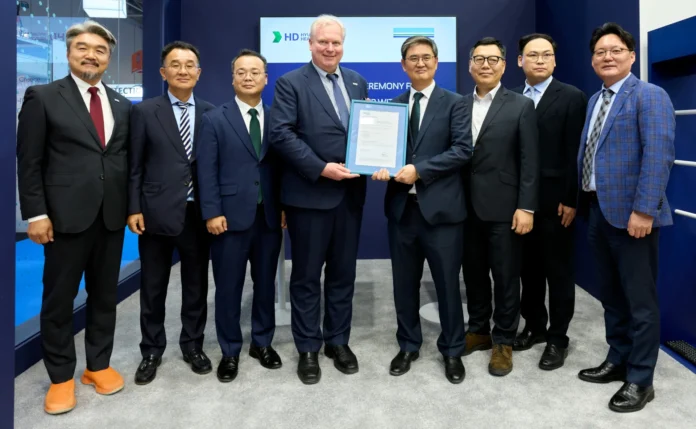
DNV has awarded an Approval in Principle (AiP) to HD Hyundai Heavy Industries for a new LPG dual-fuel 1,400 TEU container vessel design aimed at the smaller container segment.
The certificate was presented during Posidonia 2026 in Athens.
The design targets smaller container ships, a segment where alternative fuel adoption has progressed more slowly compared to larger vessels.
While LNG remains the dominant alternative fuel choice for container shipping, LPG is emerging as another pathway to lower emissions and improved efficiency.
HHI designed the vessel to balance operational flexibility, lower emissions and reduced technical complexity.
The shipbuilder developed the concept using an arrangement similar to LNG fuel systems. The approach aims to lower technical risk while maintaining operational reliability.
The design places accommodation blocks forward to maximize container intake while keeping crews separated from hazardous areas.
HHI positioned the Type-C LPG fuel tank, LPG Low Flashpoint Fuel Supply System (LFSS) and bunkering station on the aft open deck. This arrangement improves cargo handling and reduces operational risks near accommodation spaces.
The vessel design also includes a composite boiler integrated with an LPG Gas Combustion Unit (GCU) to manage boil-off gas efficiently.
“Receiving DNV’s AiP for our first LPG dual-fuel container vessel design reflects our commitment to developing practical and scalable solutions for maritime decarbonization,” said Hongryeul Ryu, CTO of HD Hyundai Heavy Industries.
He added that the design balances efficiency, cost and environmental performance while minimizing technical risks.
Vidar Dolonen, Regional Manager Korea & Japan at DNV Maritime, said the industry continues moving toward a multi-fuel future.
“This new design provides the small container segment a credible path towards lowered emissions today, balancing outlays while preserving flexibility,” he noted.
An Approval in Principle confirms the feasibility of a concept and verifies that no major technical barriers exist for implementation.