
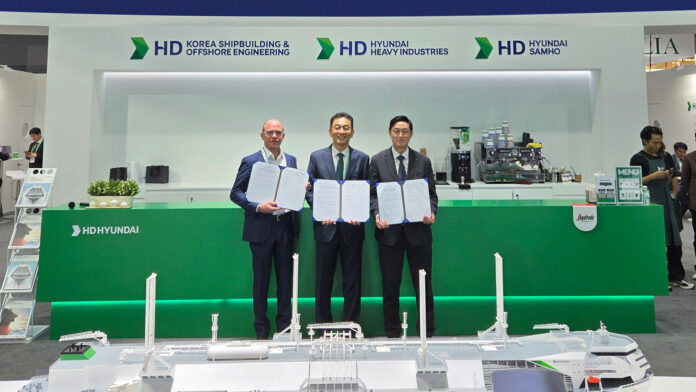
ABS, HD Korea Shipbuilding & Offshore Engineering (HD KSOE) and Siemens have signed a memorandum of understanding to develop digital twin technology for assessing the safety of ammonia-fuelled vessels.
Announced at Gastech 2026, the collaboration will combine computational fluid dynamics (CFD) analysis with digital twin technology. The partners aim to predict how ammonia could disperse following a leak and assess different accident scenarios during the early stages of vessel design.
Partners target faster ammonia safety assessments
Under the agreement, HD KSOE will develop ammonia safety systems and lead related experimental research. Siemens will provide simulation analysis and digital twin technology, while ABS will develop a safety assessment methodology based on digital twins.
“By pairing CFD analysis with digital twin technology, this project gives designers a faster, more rigorous way to understand leak behavior,” said Patrick Ryan, Senior Vice President and Chief Technology Officer, ABS.
The project aims to support faster safety validation as the maritime industry continues to explore ammonia as an alternative marine fuel.
HD KSOE also expects AI and digital twin technologies to play a growing role in shipbuilding research and development.
“We expect the integration of AI and digital twin technologies to accelerate further in the R&D field as well,” said Chang Kwangpil, Head of the Future Technology Institute, HD KSOE.
The latest initiative follows broader cooperation between ABS and HD KSOE on digital shipbuilding technologies. Earlier this year, the companies agreed to work on digital engineering, autonomous vessel systems and cybersecurity solutions.