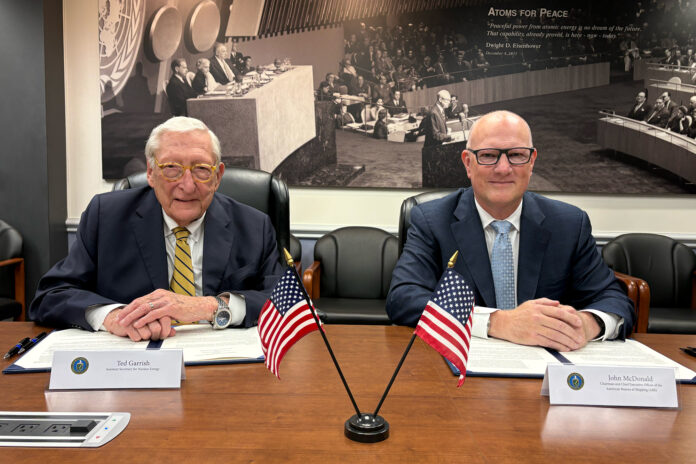
The American Bureau of Shipping (ABS) and the US Department of Energy (DOE) have signed a memorandum of understanding to advance the development of nuclear technology for commercial maritime applications.
The agreement covers nuclear-powered vessels, floating nuclear power facilities and the infrastructure required to support their operation. It also aims to strengthen US shipbuilding capabilities and examine how advanced nuclear systems could be safely introduced into the maritime industry.
The partnership will focus on technical and feasibility studies, including the potential development of nuclear-powered shipping routes and floating power solutions. It will also examine the requirements for ports, shipyards and other facilities involved in building and maintaining nuclear-powered maritime assets.
Cooperation on technology and maritime infrastructure
Under the agreement, ABS will work with the DOE’s Office of Nuclear Energy on technical, regulatory, economic and policy assessments. The classification society will also co-manage the Maritime Nuclear Applications Group (MNAG), supporting coordination between government agencies and industry stakeholders.
Additional activities will be coordinated through the US Maritime Administration’s Center for Maritime Innovation, where ABS serves as Secretariat.
“Advanced nuclear technology is moving from concept to application, and the maritime industry needs to be ready for it,” said John McDonald, Chairman and CEO of ABS.
The cooperation builds on ABS’s existing work in maritime nuclear technology, including the publication of classification rules for floating nuclear power plants and approvals in principle for several nuclear-related projects.
Focus on future commercial applications
The DOE sees advanced nuclear technology as a potential opportunity for the US maritime and shipbuilding sectors. Its collaboration with ABS will explore how existing nuclear expertise can support new commercial applications while addressing safety and regulatory requirements.
The agreement establishes a framework for further research and industry coordination rather than committing the parties to specific vessel construction projects.
No investment value, construction programme or deployment timetable has been announced.