

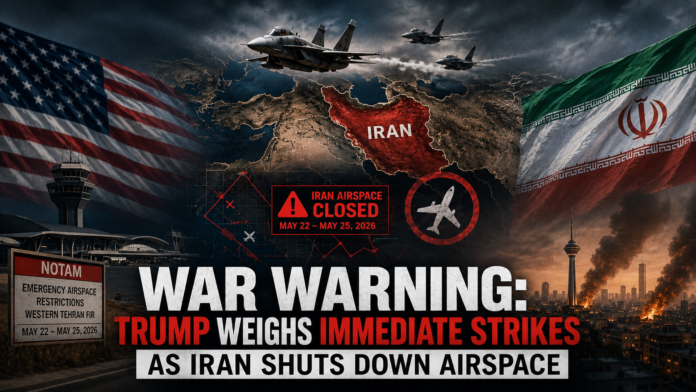
The diplomatic standoff between Washington and Tehran has reached a critical point. The situation has shifted from slow negotiations to immediate military readiness. The US administration is reviewing options for swift military action if last-minute talks fail to break the deadlock. In response to the growing pressure, Iranian authorities closed major parts of their domestic airspace. This shows that both nations are preparing for a potential collapse of the fragile peace.
Trump reviews military options for the holiday weekend
The sudden acceleration of the crisis follows a briefing at the White House. US President Donald Trump met with his senior national security team. According to Axios, the US president is seriously considering the possibility of resuming military operations against Iran if a last-minute agreement is not reached through negotiations.
The active planning has already changed official schedules. According to US officials cited in reports, the administration considers a high-intensity, short-duration military operation during the three-day Memorial Day weekend to offer a strategic advantage. White House officials emphasize that the administration remains clear about the consequences if Iran rejects a final offer. Corporate risk analysts note that the focus centers on a brief but intense campaign to force a quick conclusion to the conflict.
Diplomacy stalls as mediators exit Tehran
This shift toward military readiness matches a clear slowdown on the diplomatic front. For days, regional intermediaries have tried to bridge the gap between the two sides. According to regional reports, a high-level Qatari delegation arrived in Tehran alongside Pakistan’s military chief, Asim Munir, in a coordinated effort to save the faltering framework.
However, current assessments describe the ongoing talks as exceptionally difficult. The draft proposals fail to resolve core disagreements. The sensitivity of the situation became clear on Friday. Flight tracking data showed a Qatari government aircraft leaving Tehran shortly after the meetings ended. According to Iranian media, Pakistani representatives are still scheduled for final discussions with Iranian security officials, but domestic state-linked outlets acknowledge that a final agreement remains out of reach.
Tehran issues emergency NOTAM and shifts to a defensive posture
Anticipating a potential escalation, the Civil Aviation Organization of Iran issued an emergency Notice to Air Missions, or NOTAM. The directive orders the immediate closure of almost all airports across the western section of the Tehran Flight Information Region.
According to the official aviation directive, the emergency restrictions apply from May 22 through May 25, 2026. The mandate halts standard commercial aviation throughout the zone. It permits only a limited number of daytime commercial operations. Under the new mandate, all air carriers routing near or over Iranian territory must secure real-time clearance from the domestic aviation branch. Military analysts view the sweeping restriction as a direct defensive step to secure domestic airspace against potential incoming strikes.
Implications for global trade routes
The combination of stalled negotiations, emergency airspace closures, and impending military deadlines has placed international logistics on high alert. Security firms are advising commercial airlines and maritime operators to implement immediate diversion plans away from the central Persian Gulf corridor. With both the airspace and surrounding shipping lanes facing institutional blockades, the broader consumer market is bracing for a fresh wave of supply chain volatility. This proves that even localized diplomatic friction can instantly disrupt global distribution networks.