

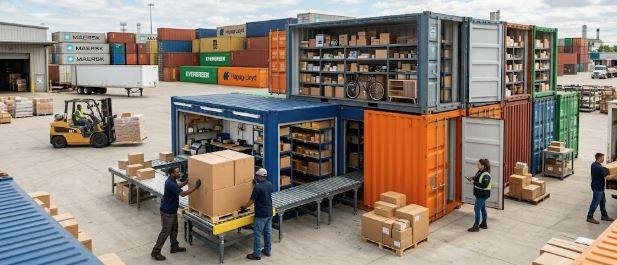
Retailers and e-commerce businesses are under constant pressure to store more inventory, fulfill orders faster, and control operating costs at the same time. Traditional warehouse expansion is not always practical, especially for companies dealing with seasonal peaks, limited real estate, or rising lease rates. In many cases, portable storage containers offer a flexible and cost-effective alternative that supports growth without requiring a major long-term facility commitment.
Why Storage Flexibility Matters in Modern Commerce
The way companies handle inventory is really different now than it was ten years ago. Stores that people can visit are now supposed to help people who shop in the store and people who buy things online. Online stores have to be able to react when people want things, when they have sales, or when they need to get things to people quickly. This means we need storage systems that can grow with the company, are easy to get to, and can be changed easily.
For many businesses, fixed warehouse space becomes inefficient when inventory levels fluctuate throughout the year. A retailer may need extra room before the holiday season, during back-to-school campaigns, or when introducing a new product line. An online seller may suddenly need overflow capacity after a successful promotion or marketplace expansion. Shipping containers help solve this problem by adding storage capacity exactly where and when it is needed.
What Makes Shipping Containers a Practical Business Asset
Shipping containers are durable steel units originally designed to move goods across long distances in demanding environments. That same durability makes them highly effective for commercial storage. Once placed on-site, they can function as:
- secure inventory rooms
- equipment storage areas
- temporary distribution points
- backstock spaces
One of their main advantages is simplicity. Businesses do not need to invest in permanent construction or sign long-term leases just to create more storage. A container can often be delivered and put into use much faster than expanding a building or relocating to a larger warehouse. This makes it especially attractive for growing companies that need immediate solutions without taking on unnecessary overhead.
Another important benefit is mobility. If a company relocates, opens a second site, or changes its operating model, the container can often move with the business. That level of flexibility is difficult to match with traditional storage infrastructure.
Cost Efficiency and Profit Potential
Profitability in retail and e-commerce often depends on operational efficiency rather than just sales volume. When storage costs rise too quickly, margins shrink. Shipping containers can help preserve margins by reducing the need for expensive off-site warehousing or rushed building improvements.
Compared with renting additional commercial space, containers are often more budget-friendly over time. Businesses can use them to store:
- surplus stock
- packaging materials
- point-of-sale displays
- seasonal merchandise
- returns processing supplies
They can also reduce secondary costs, including:
- repeated transport between locations
- slower restocking processes
- staff time lost accessing off-site inventory
- workflow interruptions during busy periods
When inventory is stored closer to the point of sale or fulfillment area, staff can access it faster, and operations become more efficient for many businesses, which directly supports profitability.
Ideal Use Cases for Retail Businesses
Retail companies can use shipping containers in several practical ways. For example:
- Stores with limited backroom space can place a container behind the building to hold extra merchandise.
- Retailers can store promotional materials, fixtures, or packaging supplies without overcrowding the shop floor.
- Seasonal businesses can keep holiday or event-related stock nearby until it is needed.
- Multi-location retailers can use containers during renovations, store resets, or relocations.
- Pop-up retail operators can use containers as temporary support storage for short-term campaigns.
This is especially useful for furniture stores, hardware suppliers, garden centers, apparel outlets, and discount retailers that regularly handle bulky or high-volume stock.
How E-commerce Operations Benefit
For e-commerce sellers, speed and organization are critical. Delays in picking, packing, and replenishment can affect customer satisfaction and increase the risk of negative reviews or canceled orders. Shipping containers support e-commerce growth by creating extra storage near fulfillment activity without requiring immediate investment in a larger warehouse.
Smaller online brands often start from a workshop, garage, or compact commercial unit. As order volume grows, storage becomes one of the first operational bottlenecks. A container can serve as overflow storage for finished products, raw materials, shipping boxes, inserts, and returned items. This keeps the main work area less crowded and more productive.
Containers can also support inventory segmentation. For example, a business may dedicate one unit to seasonal stock, one to slow-moving items, and one to packaging materials. This improves stock visibility and helps teams manage space more efficiently. In practical terms, better organization reduces wasted time, lowers handling errors, and improves overall workflow.
Security, Durability, and Inventory Protection
Any storage solution must protect inventory, not just hold it. Shipping containers are designed from strong steel and are well-suited for commercial environments where security matters. Their key protective advantages include:
- durable steel construction
- reliable physical security with proper locks
- weather resistance in outdoor settings
- suitability for modification with shelving, lighting, and ventilation
That said, successful use depends on choosing the right type of container and maintaining it properly. Businesses storing moisture-sensitive goods should consider ventilation and interior conditions carefully. Clean, dry, and well-maintained units are essential for preserving product quality.
A Scalable Solution for Growing Businesses
One reason shipping containers remain attractive is that they scale well. A business does not need to overcommit from the start. It can begin with one container, evaluate how effectively it improves operations, and add more units as needed. This staged approach reduces risk and aligns storage investment more closely with actual business growth.
For companies navigating uncertain demand, that flexibility is especially valuable. Instead of building permanent capacity for a future that may or may not arrive, they can respond incrementally. This makes storage planning more practical and financially controlled.
In the long run, shipping containers are not just about saving space. They help businesses build a more agile operating model. Retailers can respond faster to demand spikes. E-commerce companies can improve stock handling without rushing into warehouse expansion. And for businesses considering broader container-based infrastructure, resources such as what you need to know to build with shipping containers https://www.e-architect.com/articles/how-to-build-with-shipping-containers can provide useful background.
As a result, shipping containers are more than a temporary fix, they are a smart, profitable storage strategy for companies that want flexibility, efficiency, and room to grow.