
The global liner shipping industry has entered a new operating model characterised by fewer port calls while maintaining a broad network of direct trade connections, according to a new analysis by Sea-Intelligence.
The report shows that although carriers have largely preserved their geographical network reach since the disruptions of 2020, they have significantly reduced service frequencies, resulting in a structurally leaner global network.
According to Sea-Intelligence, the number of unique direct deep-sea port pair connections increased from 6,553 in January 2012 to a peak of 12,056 in 2018, while monthly vessel calls rose from 42,129 to 81,926 over the same period. However, this long-standing correlation broke down during 2020.
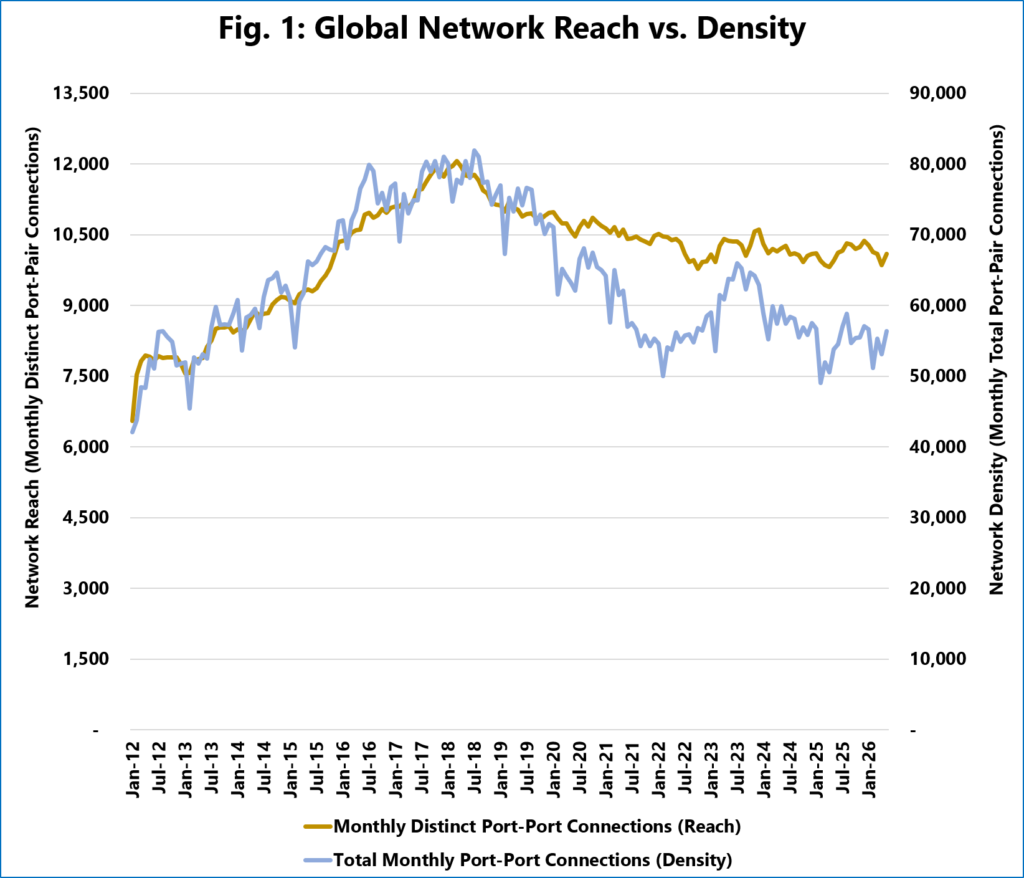
Network Reach has since stabilised at around 9,800-10,400 direct port pair connections, while Network Density—the total number of monthly port calls—has settled at a much lower range of 53,000-65,000 calls.
“The industry has seemingly established a leaner operational baseline, opting to preserve a wider network while lowering the frequency of direct port calls and pushing more volume through transshipment,” said Alan Murphy, CEO of Sea-Intelligence.
The findings suggest that carriers are prioritising network coverage while relying more heavily on transshipment hubs to maintain global connectivity, reflecting a structural change in liner network design rather than a temporary response to market disruptions.