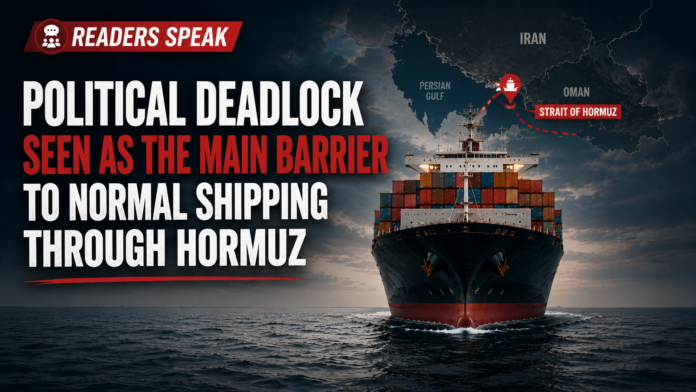

The latest Readers Speak poll asked readers what is currently preventing a return to normal shipping through the Strait of Hormuz.
The response was decisive.
An overwhelming majority of participants identified ongoing political deadlock as the biggest obstacle, far ahead of security concerns, transit controls, or market confidence issues.
The results suggest that, in the eyes of the industry, the future of shipping through the region depends less on operational measures and more on whether a political breakthrough can be achieved.
Political deadlock dominates industry sentiment
Most respondents believe the lack of a final agreement between the United States and Iran remains the primary factor preventing the normalization of shipping activity.
Despite ongoing negotiations and reports of progress toward a broader framework, major issues remain unresolved, while the US blockade continues and transit restrictions remain in place.
For many readers, uncertainty surrounding the diplomatic process is creating a greater obstacle than the physical challenges of navigating the region.
Security risks remain a concern
The second most selected option pointed to rising security risks.
Recent months have seen vessel attacks, seizures, military exchanges, and disruptions affecting commercial traffic throughout the Gulf region.
While security concerns remain important, the poll suggests readers increasingly view them as a consequence of the wider political situation rather than the root cause of the problem.
Transit controls attract limited support
Only a small share of participants selected Iran’s tighter transit control measures as the main obstacle.
This comes despite recent announcements requiring vessels to obtain authorization before transiting through the Strait of Hormuz.
The results indicate that readers view these measures as part of the broader geopolitical environment rather than the principal factor preventing a return to normal operations.
Confidence follows political stability
A limited number of respondents identified lack of market confidence as the key issue.
However, confidence in shipping markets is often linked directly to political and security developments.
Many readers appear to believe that confidence will return naturally once a durable diplomatic solution is reached and shipping conditions become more predictable.
The industry is waiting for clarity
The findings reveal a growing consensus among readers that the future of shipping through the Strait of Hormuz depends primarily on political decisions rather than operational adjustments.
While carriers, ports, insurers, and cargo owners continue adapting to changing conditions, the poll suggests that many industry participants see diplomacy as the decisive factor that will determine when normal trade flows can fully resume.
Conclusion
Readers send a clear message:
The biggest barrier to restoring normal shipping through the Strait of Hormuz is the continuing political deadlock between the parties involved.
Until meaningful progress is achieved, uncertainty is likely to remain a defining feature of container shipping in one of the world’s most strategically important maritime corridors.