
Project Trident moved a step closer to reshaping Greece’s shipbuilding landscape after ONEX Shipyards & Technologies Group and Hanwha Ocean unveiled a €1.35 billion investment roadmap designed to transform Elefsina into a major regional shipbuilding, logistics, and defence manufacturing hub.
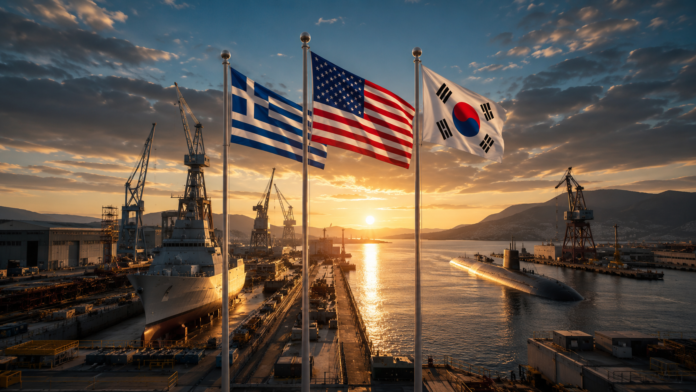
The initiative, presented during the signing ceremony of the strategic alliance agreement between ONEX and Hanwha Ocean at the US ambassador’s residence in Athens, forms part of a broader trilateral cooperation framework involving Greece, the United States, and South Korea. The project aims to strengthen shipbuilding capacity, enhance industrial capabilities, and position Greece as a strategic maritime manufacturing centre in the Eastern Mediterranean.
US Ambassador to Greece Kimberly Guilfoyle described the agreement as more than a commercial partnership, saying it reflects a broader strategic alignment between the three countries focused on maritime security, industrial cooperation, and long-term economic growth. She stated that the United States stands alongside Greece and South Korea in efforts to strengthen maritime capabilities and build a more secure future.
Under @POTUS’ leadership, America is working with our valued partners Greece and the Republic of Korea to bring back maritime dominance! I was honored to host ONEX and Hanwha Ocean for a signing ceremony that cements cooperation in shipbuilding between our three great nations.… pic.twitter.com/n3P3vjK4aI
— Ambassador Kimberly Guilfoyle (@USAmbassadorGR) May 30, 2026
Greek Deputy Foreign Minister Haris Theocharis said the partnership combines American defence support, South Korean shipbuilding expertise, and Greek industrial capabilities to create a new strategic industrial ecosystem centred around Elefsina. He noted that the initiative carries significance not only for Greece’s industrial future but also for wider regional security cooperation.
At the centre of Project Trident is a three-phase investment programme valued at €1.35 billion.
The first phase, representing an investment of €150 million, focuses on expanding ship repair and maintenance capabilities through new facilities, larger dry docks, and upgraded maintenance, repair and overhaul (MRO) infrastructure. The expansion is expected to strengthen support capabilities for commercial fleets, allied naval forces, and large-scale vessel servicing operations.
The second phase, valued at €200 million, targets port infrastructure modernisation and logistics expansion. Planned upgrades include dual-use port facilities, logistics enhancements, and supply chain infrastructure aimed at increasing Elefsina’s operational capacity and regional competitiveness.
The third and largest phase involves approximately €1 billion in investments dedicated to advanced industrial infrastructure, automated production systems, robotics, artificial intelligence applications, and specialised facilities capable of supporting advanced naval programmes, including submarine-related capabilities.
ONEX Chairman and Chief Executive Panos Xenokostas described the agreement as a milestone for the country’s industrial future, arguing that Greece has the opportunity to evolve from a buyer of defence systems into a producer and long-term support hub for advanced naval capabilities. He added that the initiative could restore Greece’s position among major shipbuilding nations while strengthening industrial sovereignty.
Hanwha Ocean Vice President Sean Seongwoo Park highlighted Greece’s geographic position as a strategic gateway connecting Europe, the Mediterranean, and global shipping routes, adding that technology transfer and long-term industrial cooperation will form key pillars of the partnership. South Korean Ambassador Ju-seong Lim also described the trilateral cooperation as a strategic framework capable of creating lasting industrial value across all participating countries.
According to projections presented during the event, Project Trident could generate up to 10,000 direct and indirect jobs, contribute approximately 0.8% annually to Greece’s GDP, and achieve domestic industrial participation levels of up to 70% across future programmes. Officials also indicated that the hub could support requirements not only for the Hellenic Navy but also allied naval forces operating across the Eastern Mediterranean, Black Sea, and Southeastern Europe.
For Greece’s maritime sector, Project Trident represents more than a shipyard investment. It signals a broader effort to reposition the country as a regional shipbuilding, repair, and industrial powerhouse at a time when supply chain resilience, naval capacity, and industrial independence are becoming increasingly important strategic priorities.