

Industry looks beyond immediate disruption
The latest Readers Speak poll explored how the container shipping industry may adapt in the long term to the ongoing crisis surrounding the Strait of Hormuz.
The results suggest that readers increasingly believe the industry’s response will extend far beyond temporary operational measures, with infrastructure and routing strategies expected to evolve permanently.
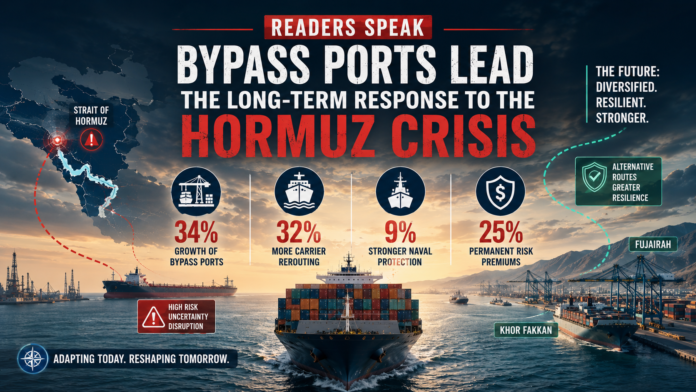
Among all options, the strongest response pointed toward the growth of bypass ports as the most significant long-term outcome of the crisis.
Bypass ports emerge as the leading expectation
A large share of participants believes ports located outside the Strait of Hormuz will gain strategic importance as carriers and governments seek greater resilience against geopolitical disruption.
The findings reflect growing attention on alternative Gulf gateways and infrastructure capable of reducing dependence on one of the world’s most sensitive maritime chokepoints.
For many readers, the crisis has reinforced the importance of:
- diversified maritime access
- alternative logistics corridors
- and contingency-focused port development
Carrier rerouting seen as a lasting strategy
Closely behind bypass ports, many respondents expect carrier rerouting to remain a long-term operational reality.
This suggests the industry increasingly views rerouting not as a temporary emergency measure, but as an established part of future network planning.
Ongoing security concerns, unpredictable transit conditions, and geopolitical instability continue to influence carrier decision-making across the region.
Risk premiums remain part of the outlook
A notable share of readers believes elevated costs and permanent risk premiums will continue shaping container shipping economics even after the immediate crisis phase.
This reflects expectations that insurers, carriers, and cargo owners may continue pricing geopolitical instability into operations for the foreseeable future.
Limited confidence in naval protection as a solution
Only a small portion of participants identified stronger naval protection as the main long-term response.
This may indicate that readers see structural adaptation and commercial flexibility as more sustainable solutions than relying solely on military security measures.
From disruption to structural change
The results highlight an important shift in industry thinking.
Earlier discussions focused largely on:
- immediate disruption
- vessel safety
- and short-term operational impacts
Now, readers increasingly appear focused on:
- long-term resilience
- infrastructure positioning
- and permanent changes in shipping networks.
Conclusion
Readers send a clear message:
the Hormuz crisis is expected to accelerate structural changes across container shipping, particularly through the rise of bypass ports and long-term rerouting strategies.
Rather than viewing the situation as a temporary disruption, many now see it as a catalyst for lasting transformation in regional and global shipping networks.