
Since late 2023, attacks on merchant shipping around the southern Red Sea have changed how many carriers route between Asia, the Red Sea, the Gulf and East Africa. Much of the public discussion has focused on standard containers and headline freight rates.
For shippers of project and oversized cargo, such as machinery, generators, steel structures and plant modules, the change has been more awkward. Their cargo depends on special equipment, careful planning and fewer options. This piece does not try to predict when conditions will change. It sets out the practical questions we now work through on every out-of-gauge file headed to these regions.
Suez or the Cape: a decision made shipment by shipment
For cargo moving between Asia and Europe or the Mediterranean, many carriers have chosen the Cape of Good Hope over the Suez Canal. That adds sailing time and changes port rotations. For cargo whose destination is itself on the Red Sea, such as Jeddah, Port Sudan, Aqaba or Hodeidah, sailing around the Cape is not the answer. The question becomes which carriers still call, how they call, and through which hub.
This means routing decisions are made shipment by shipment rather than lane by lane. A routing that worked last quarter may not be offered now, and the same carrier may treat different destination ports differently. For oversized cargo, which often has a fixed site date and limited equipment, a quote should state the actual routing and carrier. A generic transit time is not enough.
Hub switching and the extra handling it brings
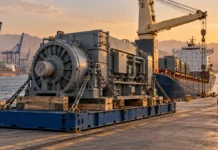
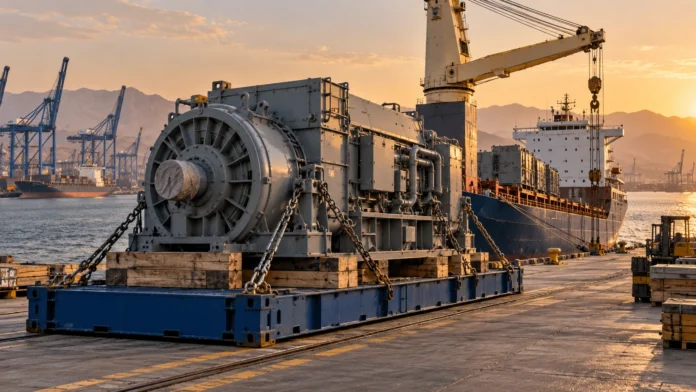
When direct calls are withdrawn, cargo is often moved through a transhipment hub and then a feeder or regional service. For standard boxes, that mostly means extra time. For project cargo, every extra lift is a risk. A flat rack carrying an over-width unit must be handled, stowed and lashed correctly at each terminal. Not every hub or feeder vessel is equally suited to out-of-gauge units.
Before booking, we ask three things. Will the hub accept the unit’s dimensions and weight? Can the connecting vessel stow it on or under deck as needed? How long is the unit likely to wait for a connection? A switch of hub after booking can mean a new acceptance process, so it pays to confirm acceptance with the carrier for the full routing, not only the first leg.
Flat racks and open tops: equipment is part of the plan
Special equipment is not evenly distributed. Flat racks and open-top containers have to be positioned where the cargo is. When services change, empty special equipment can end up in the wrong place. Shippers should ask early whether the required equipment is available at the loading port for the intended sailing, and plan production around it.
When out-of-gauge acceptance on container services is limited, breakbulk or a combination of containers and breakbulk becomes a real option. For some units, conventional vessels or multipurpose ships offer a more direct route to the destination than a container network that has been redesigned around the disruption. The right answer depends on dimensions, weight, destination port facilities and timing.
War-risk insurance and surcharges
Carriers may apply war-risk or emergency surcharges on affected lanes, and marine insurers may apply additional premiums for voyages through listed areas. These can change at short notice. Shippers should check three things.
Does the freight quote include or exclude these surcharges? Does the cargo insurance policy cover the actual routing, including any listed areas? Who under the agreed Incoterm bears the cost if surcharges are introduced after booking? Agreeing this clearly in the sales contract avoids disputes later.
Documents: small errors, large delays
Rerouting and transhipment add places where documents can cause trouble. Bills of lading must reflect the actual port of discharge and any agreed place of delivery. For project cargo, packing lists should give accurate dimensions and weights for every piece, together with lifting points and centre-of-gravity details where relevant.
Several destinations in the Red Sea, Gulf and East Africa have their own import documentation, pre-shipment certification or registration requirements. These should be confirmed with the consignee and destination agent before the cargo leaves origin, not after it arrives.
What shippers can do now
The common thread is to plan earlier and in more detail. In practice, that means:
– Get routing and carrier details in writing for the specific destination port.
– Confirm out-of-gauge acceptance for every leg, including the hub.
– Check special equipment availability before fixing production dates.
– Compare container and breakbulk options for oversized units.
– Clarify war-risk surcharges and insurance cover against the actual routing.
-Confirm destination document requirements before shipment.
Conditions on these lanes may continue to shift, and I will not try to say how or when. What does not change is that project cargo rewards careful preparation. Shippers who ask these questions early keep more options open when routings move.
About the author
Delia Qu is Deputy General Manager at Dalian Yihang Shipping Agency Co., Ltd., a Class-1 international freight forwarder, NVOCC and AEO Advanced Certified customs broker in Dalian, China. She has more than ten years of experience in freight forwarding. Founded in 2020, the company handles ocean FCL and LCL, air freight, China–Europe rail, project and breakbulk cargo, and exhibition cargo to more than 80 countries through 180+ overseas agents.