
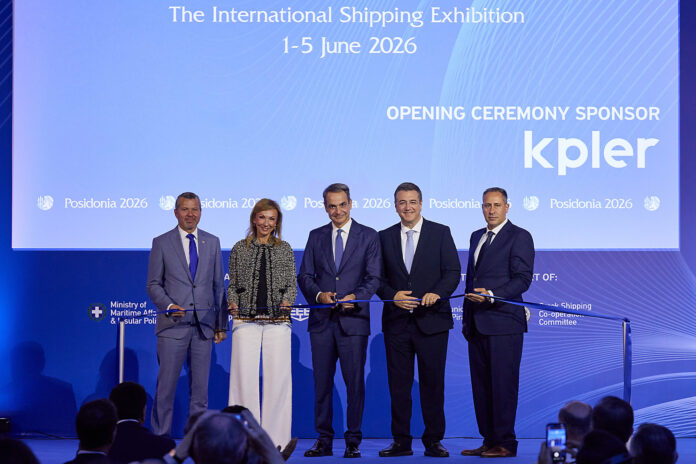
Posidonia 2026 officially opened in Athens against one of the most challenging geopolitical backdrops in recent maritime history, with industry leaders warning that prolonged disruptions in the Strait of Hormuz and Red Sea are testing the resilience of global shipping and supply chains.
The opening ceremony at Athens Metropolitan Expo gathered more than 800 maritime executives, government officials and international stakeholders, including Greek Prime Minister Kyriakos Mitsotakis, International Maritime Organization Secretary-General Arsenio Dominguez, European Commissioner for Sustainable Transport and Tourism Apostolos Tzitzikostas and Union of Greek Shipowners President Melina Travlos.
Posidonia 2026 is the largest edition in the exhibition’s history, bringing together 2,227 exhibitors from 83 countries and territories across 45,000 square metres of exhibition space. Organisers expect more than 40,000 participants during the week-long event.
The closure of the Strait of Hormuz dominated discussions throughout the opening ceremony.
IMO Secretary-General Arsenio Dominguez highlighted the strategic significance of the region, noting that Hormuz handles around 20 million barrels of oil daily, roughly 25% of global seaborne oil trade and nearly 20% of global LNG trade. He also pointed to continuing disruptions in the Red Sea, where instability continues affecting trade flows through the Suez Canal.
Melina Travlos stressed that shipping should never become a target during geopolitical crises and warned that disruptions at sea directly affect the functioning of the global economy. She called freedom and safety of navigation essential conditions for global prosperity and international stability.
Travlos also urged policymakers to place shipping protection at the center of strategic decision-making.
“Without freedom of navigation, there can be no global prosperity,” she stated while emphasizing the need for realism in shipping’s green transition.
Decarbonization remained another major theme during the opening session.
Travlos said shipping continues investing heavily in cleaner technologies and alternative fuels but warned that the sector’s transition depends heavily on external factors, including fuel availability, infrastructure and technology readiness. She added that shipping currently accounts for only 1.6% of global greenhouse gas emissions despite remaining one of the hardest sectors to decarbonize.
European Commissioner Apostolos Tzitzikostas highlighted the importance of shipping to Europe’s economy, noting maritime transport carries 76% of EU imports and 73% of exports. He also pointed to new European strategies targeting shipping competitiveness and port development.
Prime Minister Kyriakos Mitsotakis described Greek shipping as both a national and European strategic asset, stressing its growing role in economic resilience and geopolitical stability.
Beyond geopolitics, Posidonia 2026 reflects the industry’s technological shift.
More than 30 exhibitors are showcasing artificial intelligence applications for maritime operations, while approximately 100 exhibitors are presenting environmental technologies supporting decarbonization efforts. Nuclear energy is also emerging as a key discussion point during this year’s event agenda.
As global shipping faces rising geopolitical risks, regulatory pressure and changing trade patterns, Posidonia 2026 opens with one message dominating discussions across Athens: shipping remains indispensable to global trade, energy security and economic stability.