

PortSide Stories: Dublin
Ireland’s Maritime Gateway to the World
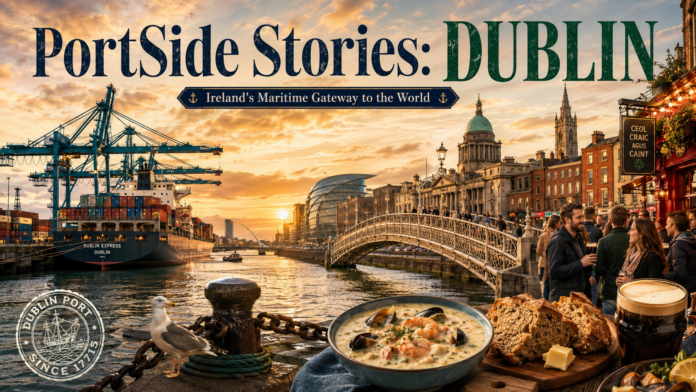
The Port of Dublin sits at the heart of Ireland’s maritime trade. Located where the River Liffey meets Dublin Bay, the port connects the Irish capital with markets across Europe and beyond.
Today, Dublin handles containers, Ro-Ro traffic, ferries and other cargo. Its location beside Ireland’s largest city makes it a vital link between international shipping and the country’s economy.
Beyond the working waterfront lies Dublin itself, a city of Georgian streets, historic landmarks, lively pubs and a maritime identity shaped by centuries of trade.
Dublin: Ireland’s Main Maritime Gateway
Dublin Port is Ireland’s largest freight and passenger port. It handles a major share of the country’s international trade and provides regular connections with ports in Britain and continental Europe.
Container services form an important part of this activity. At the same time, Ro-Ro and ferry traffic keep goods and passengers moving across the Irish Sea.
The port also benefits from its location close to Dublin’s businesses, consumers and transport network. As a result, it remains a crucial gateway for Ireland’s supply chains.
A City Shaped by the River and Sea
Dublin’s story is closely connected to the River Liffey and the sea.
The city’s waterfront developed through centuries of trade, ship movements and migration. Docklands, quays and warehouses helped shape Dublin as it expanded into an important European capital.
Today, the Docklands tell a different story. Modern offices and public spaces stand beside reminders of the area’s industrial and maritime past.
A walk along the Liffey offers a glimpse of both old and new Dublin.
Taste the Flavors of Dublin
Dublin offers plenty of comforting Irish classics.
Start with a bowl of seafood chowder, often packed with fresh fish and shellfish. Traditional Irish stew, made with lamb or mutton, potatoes and vegetables, is another local favorite.
You can also try boxty, an Irish potato pancake, or enjoy fresh soda bread with butter. For something closely associated with the capital, look for Dublin coddle, a traditional dish made with sausages, bacon, potatoes and onions.
Of course, Dublin’s pub culture is part of the experience. A visit to a traditional pub offers the chance to enjoy Irish food, live music and the city’s famous social atmosphere.
Discover Dublin’s Essential Landmarks
Begin at Trinity College Dublin, one of Ireland’s most famous institutions. Its historic library is home to the celebrated Book of Kells.
Don’t forget to visit Dublin Castle, which has played a central role in Irish history for centuries.
Continue to St Patrick’s Cathedral, one of the city’s most important religious and architectural landmarks.
For a different side of Dublin’s identity, explore the Guinness Storehouse, which tells the story of Ireland’s most internationally recognized stout.
Walk Through the Heart of Dublin
Cross the River Liffey over the distinctive Ha’penny Bridge, one of the city’s best-known landmarks.
From there, explore Temple Bar. Its cobbled streets are packed with pubs, restaurants, cultural venues and live music.
For a quieter walk, head through the elegant Georgian streets around Merrion Square and St Stephen’s Green. These neighborhoods reveal another side of Dublin, with colorful doors, historic houses and leafy public spaces.
Beyond the City Centre
Dublin’s coastal location makes it easy to escape the city without traveling far.
Take a short trip to Howth, a picturesque fishing village overlooking Dublin Bay. Walk along the harbor, enjoy fresh seafood or follow the coastal paths for impressive views of the Irish Sea.
Another option is Dún Laoghaire, known for its long harbor piers and seaside atmosphere.
These coastal communities show that Dublin’s relationship with the sea extends far beyond its commercial port.
Dublin in Motion
At the Port of Dublin, container vessels, ferries and cargo ships keep Ireland connected with international markets. Trucks and containers move between the terminals and the country’s transport network throughout the day.
Further along the Liffey, the working port gives way to the Docklands and the historic heart of the capital.
Few European cities place maritime commerce, history and urban life so close together.
Dublin is more than Ireland’s capital.
It is a port city whose relationship with the sea continues to shape its economy, culture and character.