

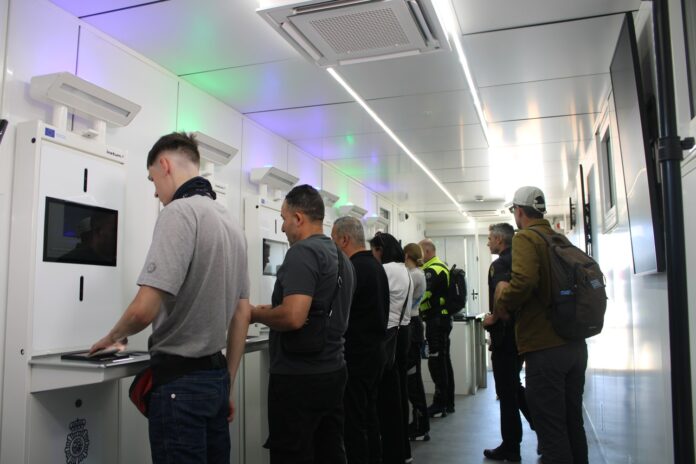
The Port of Valencia has become the first port in Spain to deploy a passenger border control system compatible with the European Entry/Exit System, establishing a facility that supports the Ministry of the Interior in managing external border operations.
The infrastructure was developed by the Port Authority of Valencia and is 75% co-financed by the European Union through the European Fund for Internal Security, with a total budget of EUR€1,174,592.59 including VAT.
The new border control station consists of an adapted container equipped for professional border management operations, featuring large windows, thermal insulation, purpose-designed lighting, furniture and state-of-the-art technology for passport scanning and passenger assistance.
Verification, monitoring and logging tablets have also been introduced to support inspection teams and improve the efficiency of border information management.
The EES system enables the recording of entry and exit data, as well as instances of denied entry, for third-country nationals crossing the external borders of EU member states.
The facility strengthens identity verification procedures, document checks and passenger services, contributing to more streamlined and secure management of migration flows at the port.
The implementation aligns with the Port Authority of Valencia’s commitment to active collaboration with the Ministry of the Interior and European institutions on external border management, and supports broader efforts to prevent, detect and investigate acts related to terrorism and other serious crimes.
The Port of Valencia’s leadership in adopting this infrastructure positions it as a reference point for other Spanish ports as the EES framework is rolled out across EU member states.