
The Freeport of Riga has attracted three international investors to develop wind technology production facilities at Kundziņsala, committing a combined investment exceeding EUR 700 million in production infrastructure to be built in phases through 2034.
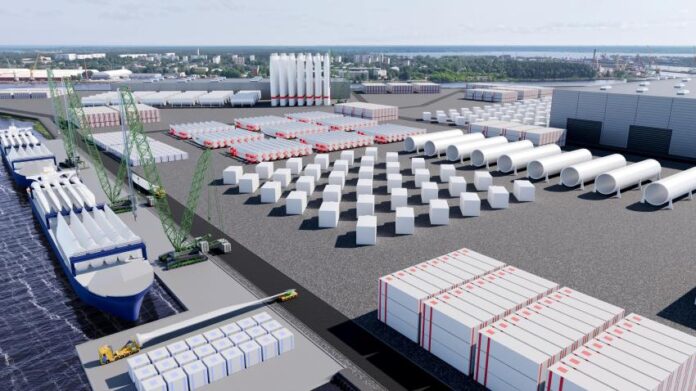
The investments are being developed within the framework of the EU co-financed project for the creation of port and logistics infrastructure for wind technology production at Kundziņsala, supported by EUR 86 million in public funding comprising European Regional Development Fund contributions, Freeport of Riga Authority financing and Latvian state co-financing.
The first investor, SIA Latvijas atjaunojamās enerģijas projekti, signed an investment agreement in December 2025 following the conclusion of the initial selection process.
The project envisages investment of between EUR 160 and 250 million in the production of wind technology components including towers, flanges, nacelles and rotors, as well as related raw materials and semi-finished steel products, creating an integrated green industry cluster and generating up to 300 direct and approximately 800 indirect jobs.
Two further investment agreements were signed in March 2026 following a second investor selection round.
UAB Eurostat 5, owned by Lithuanian renewable energy developer UAB New Energy Group, will establish a wind technology assembly and logistics centre supporting onshore and offshore wind projects through manufacturing, assembly, technical integration, testing and shipment preparation services.
Upon completion by 2034, the project is expected to create 150 to 220 jobs and handle at least 150,000 tonnes of cargo annually.
Solidior Power Ltd., a Finnish manufacturer of nickel-zinc battery systems, will develop a large-scale battery manufacturing ecosystem on Kundziņsala with a total production capacity of 6.4 GWh by 2031, representing one of the most significant Nordic-Baltic energy storage investments of the decade.
The project also facilitates the strategic transfer of US battery manufacturing technology to the European market.
Development will proceed in four phases between 2026 and 2031, with the first phase requiring approximately EUR 112 million in investment and an eventual workforce of 1,300 to 1,500 employees.
The Freeport of Riga Authority is concurrently advancing the physical infrastructure at Kundziņsala, with a deep-water berth, cargo logistics yards, utility networks, access road and railway crossing to be completed by December 2029.
Design work for the access road and rail crossings is underway, and a tender for the berth, RoRo ramp and logistics area was announced earlier this year.
The combined project is expected to create more than 2,000 new jobs and position Latvia as a central hub for wind energy manufacturing and energy storage in the Baltic region.