
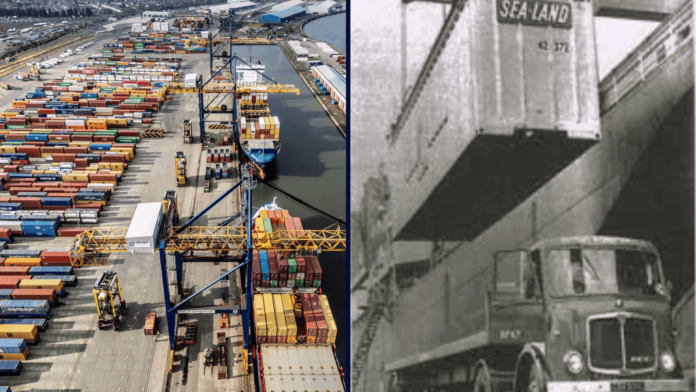
The Port of Grangemouth is celebrating the diamond anniversary of the first container vessel to call at a UK port, marking six decades since the Sea-Land freight service arrived at Grangemouth on May 7, 1966 as part of a Europe and America shipping rotation.
The port is commemorating the milestone with an £8 million investment in infrastructure and equipment, reaffirming its commitment to Scotland’s largest container port and logistics hub.
The 1966 call was historically significant as Grangemouth was the only UK port in the Sea-Land rotation, making it the first port in the United Kingdom to handle containerised cargo in what would become a transformative shift in global maritime trade.
The transatlantic service, launched in April 1966 with four vessels each carrying 226 containers, connected Grangemouth with Rotterdam, Bremen, Port Elizabeth and Baltimore on a weekly schedule, carrying goods including cameras, safety razors and prefabricated housing components alongside Scotch whisky destined for the US market.
Over the six decades since, the port has developed into a 402-acre multimodal facility employing 280 people and home to 32 businesses, handling more than £6 billion worth of goods annually including food and drink, construction products and renewables.
Since 1966, the terminal has processed in excess of 4.2 million containers in total.
The port remains primarily an export facility, moving Scottish goods to global markets.
Derek Knox, Regional Director for Scotland, described the anniversary as a significant milestone in the port’s history, highlighting its evolution through sustained investment in infrastructure, equipment and skills.
Craig Torrance, Asset Manager for the Port of Grangemouth, noted that while the port has changed dramatically over six decades in terms of vessel size, equipment sustainability and operational practices, its customer focus and its role as a gateway for Scotch whisky exports have remained constant.
To mark the anniversary, the port is planning a community open day and is engaging local schools in a project to name a new harbour crane.