
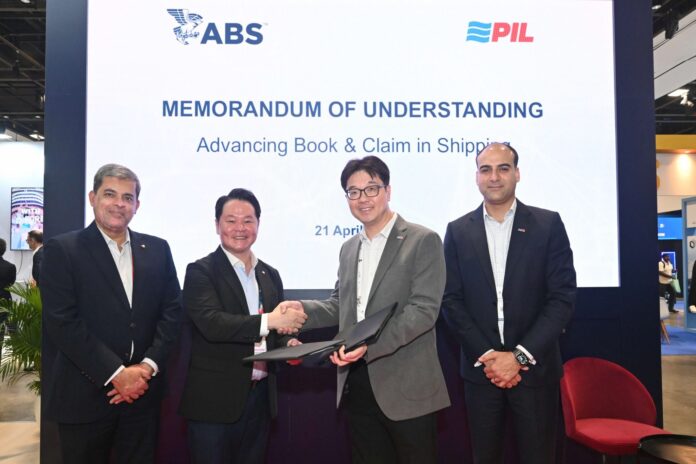
Pacific International Lines (PIL) and ABS have signed a Memorandum of Understanding (MoU) aimed at advancing maritime decarbonisation through the verification of emissions linked to alternative marine fuels.
The agreement will support PIL’s participation in Book and Claim registries, enabling independently verified emissions reduction claims tied to the use of low- and zero-emission fuels. The collaboration combines PIL’s operational expertise, fleet data and customer insights with ABS’s capabilities in classification, certification and assurance.
Under the MoU, ABS will act as an independent third-party verifier, overseeing PIL’s fuel consumption, transport activity and emissions data. The objective is to ensure transparency, consistency and credibility in emissions reporting, which is essential for the effective implementation of Book and Claim mechanisms.
“PIL is committed to advancing practical decarbonisation solutions for customers and industry. Our MoU with ABS enhances oversight and independent assurance for Book and Claim, ensuring consistent and reliable assessment of emissions and fuel data. This supports broader adoption of low- and zero-emission fuels as their availability grows, while maintaining accuracy in emissions claims,” said Abhishek Chawla, Chief Marine Officer at PIL.
“ABS is committed to helping clients navigate maritime digitalisation with clarity and confidence. As digitalisation accelerates, independent data verification is essential to building the trust that drives meaningful progress. ABS brings deep technical expertise to this work, and we are pleased to support PIL’s commitment to reducing emissions across its fleet,” said Rostom Merzouki, Vice President, Global Sustainability at ABS.
The long-term partnership will focus on improving emissions monitoring and reporting practices while supporting PIL’s broader decarbonisation strategy in line with the International Maritime Organization’s targets.
The Book and Claim model allows environmental attributes linked to cleaner fuels to be tracked and transferred independently of their physical use on specific vessels or voyages. Through a structured registry and clear governance, the mechanism enables customers to access low-emission fuel solutions and report reductions, even where direct fuel availability remains limited on certain routes.