Across global container terminals, operational fatigue has quietly become one of the industry’s biggest hidden costs.
Overtime is rising. Supervisors spend entire shifts handling exceptions. Yard teams constantly react to last-minute changes. Vessel operations drift from plan, forcing labor to absorb the pressure through continuous firefighting.
But the real issue is not labor. It is planning imperfection.
In many terminals, vessel planning, yard allocation, crane scheduling, and operational rules are still managed in disconnected layers. Small planning gaps quickly cascade into operational instability:
- Crane conflicts emerge during execution
- Yard congestion builds unexpectedly
- Berth schedules drift
- Labor deployment becomes reactive
The result is an operational environment where human operators continuously compensate for system inefficiencies. And the consequences extend beyond the terminal gate.
Even minor delays can disrupt shipping schedules, increase inventory buffers, and raise national logistics costs across supply chains. In today’s volatile maritime environment, reactive operations are no longer sustainable.
This is why more terminals are shifting toward high-precision planning powered by intelligent automation.
Why Automatic Vessel Planning Matters
The vessel plan is the foundation of terminal execution. If the vessel plan is unstable, every downstream operation becomes unstable.
Traditional planning methods often rely heavily on manual adjustments and fragmented decision-making. As vessel sizes increase and schedules become less predictable, planners are under growing pressure to optimize faster with greater precision.
This is where TOPX-Expert (TOS) changes the game.
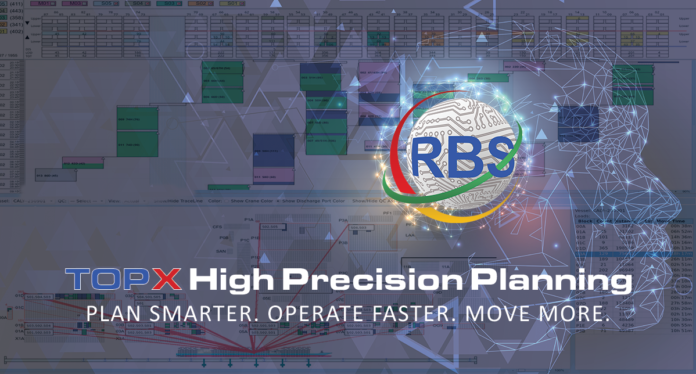
RBS’s TOPX-Expert delivers second-to-none Automatic Vessel Planning (AVP) capabilities that simultaneously consider vessel structure, crane allocation, yard positioning, operational rules, equipment constraints, and execution efficiency before operations even begin. Instead of reacting to problems after they appear, terminals can prevent avoidable exceptions upfront.
The impact is significant:
- Reduced execution drift
- Fewer operational conflicts
- More stable crane productivity
- Lower overtime dependency
- Better labor utilization
- Faster vessel turnaround
Most importantly, planners gain the ability to evaluate multiple operational scenarios before committing to execution. This transforms planning from reactive correction into predictive operational control.
From Visibility to Super-Intelligent Operations
The next step is operational intelligence.
With TOPX-Intelligent 3D X-ray and SuperIntelligent, terminals gain real-time 3D operational visibility, near-future simulation, and historical playback capabilities that function as a true digital twin environment.
Managers can see operational bottlenecks forming before congestion escalates. Alternative execution strategies can be simulated instantly. Decisions become data-driven rather than experience-driven alone.
The result is a major transition in terminal management philosophy:
- From firefighting → to foresight
- From reactive recovery → to resilient execution
- From fragmented planning → to synchronized operational intelligence
The Future Terminal Is Built on Precision
Automation alone does not create stability.
Precision planning does.
As global ports face larger vessels, tighter schedules, labor shortages, and increasing supply chain volatility, terminals need systems capable of orchestrating operations with far greater intelligence than traditional planning tools allow.
That is why Automatic Vessel Planning is no longer just a productivity feature. It is becoming the operational foundation for the next generation of super-intelligent container terminals.
This article was written by Valerie Nguyen