

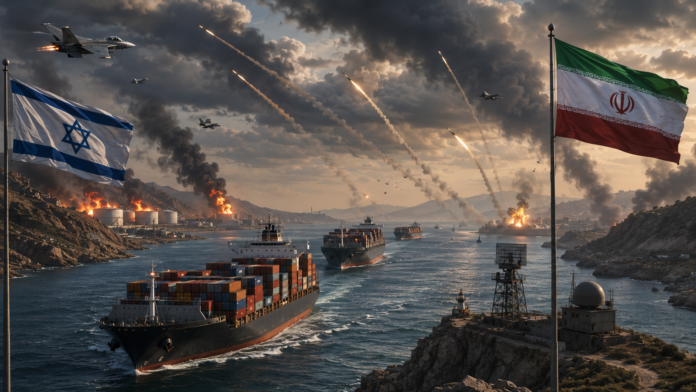
The fragile regional ceasefire established on April 8 has collapsed after a sequence of direct military exchanges between Israel, Iran, and Yemen’s Houthi rebels. The escalation has forced the United States to shutter its primary diplomatic facilities in Israel, ordering personnel into bunkers as air raid sirens echoed across the country.
The Catalyst and Crossfire
The rapid unraveling of the two-month truce began on Sunday, June 7, following a Hezbollah rocket salvo directed at northern Israel. The Israel Defense Forces (IDF) retaliated by executing a targeted airstrike on a Hezbollah headquarters in the southern suburbs of Beirut.
Tehran viewed the Beirut strike as an explicit breach of regional understandings. By Sunday night, Iran’s Islamic Revolutionary Guard Corps (IRGC) initiated “Operation Nasr” (Victory), launching a barrage of ballistic missiles aimed at Israeli military assets, including the Ramat David Air Base. While Israel’s Home Front Command activated alarms nationwide, the IDF reported its multi-layered air defenses intercepted the incoming threats.
Early Monday morning, June 8, Israel retaliated by launching waves of airstrikes against central and western Iranian territory. The Israeli Air Force struck strategic targets in major cities, including Tehran, Isfahan, and Tabriz. The strikes caused severe physical damage to key logistics links, radar installations, and a major petrochemical complex in the southern city of Mahshahr.
Houthis Re-Enter the Fray
Compounding the crisis, Yemen’s Iran-backed Houthi movement re-entered the active theater on Monday morning. The group launched a long-range ballistic missile toward central Israel, targeting the greater Jaffa and Tel Aviv metropolitan area. The strike forced Israel to temporarily halt commercial aviation and close its central airspace before the projectile was neutralized.
Immediately following the missile launch, the Houthi armed forces issued a formal decree aimed at global supply lines, declaring an absolute maritime embargo.
Statement from the Houthi Armed Forces: “We declare a complete and total ban on Israeli maritime navigation in the Red Sea. We consider all enemy movements to be legitimate military targets for our armed forces from the moment this statement is issued.”
The declaration raises immediate economic concerns for global shipping networks. A renewed Houthi blockade at the Bab el-Mandeb Strait, combined with Iran’s continuing squeeze on the Strait of Hormuz, threatens a dual chokepoint crisis for international oil and cargo transit. International shipping firms are already preparing to divert commercial fleets around Africa’s Cape of Good Hope, a move expected to trigger a swift rise in maritime insurance premiums and global energy prices.
U.S. Embassies Ordered to Bunker
The immediate threat of incoming missile trajectories prompted an emergency defensive posture from United States diplomatic missions. On Monday morning, the U.S. Embassy in Jerusalem issued a high-level security directive ordering an immediate lockdown of all diplomatic operations.
Both the core embassy building in Jerusalem and the Embassy Branch Office (proxenio) in Tel Aviv completely suspended their consular sections for Monday, June 8, canceling all routine passport and visa services.
The State Department issued a mandatory shelter-in-place order for all U.S. government employees and their immediate family members residing in Israel. Staff were instructed to remain inside fortified spaces and prepare for immediate relocation to bomb shelters upon the activation of localized “red alert” sirens.
Concurrently, U.S. officials urged private citizens in the area to download local defense applications, monitor proximity to public bomb shelters, and maintain up-to-date travel documents as international mediators work backchannels to restore a diplomatic baseline.