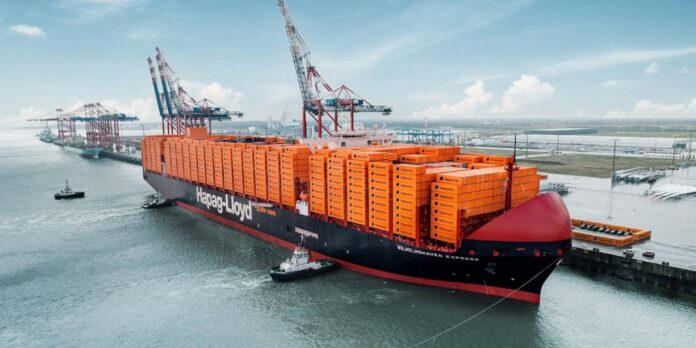
Hapag-Lloyd reported an earnings recovery in the second quarter of 2026, supported by stronger freight rates and higher container volumes. However, disruption in the Middle East created around US$600 million in additional costs during the quarter.
The German container shipping company reported Group EBITDA of US$829 million in Q2 2026, slightly above the US$820 million recorded a year earlier.
Meanwhile, Group EBIT fell to US$176 million from US$189 million. Group profit declined more sharply to US$83 million, compared with US$306 million in Q2 2025.
Revenue increased to US$5.84 billion from US$5.27 billion in the same quarter last year.
Hapag-Lloyd said the second quarter showed a clear improvement from the start of 2026. Strong exports from Asia and improved demand in the United States supported the recovery.
Freight rates rise 9% in Q2
Hapag-Lloyd’s Liner Shipping segment generated revenue of US$5.68 billion in the second quarter, up from US$5.17 billion a year earlier.
Transport volumes increased to 3.48 million TEU from 3.36 million TEU in Q2 2025.
At the same time, the average freight rate rose 9% year on year. It reached US$1,475 per TEU, compared with US$1,354 per TEU in the previous-year quarter.
Despite the stronger market, Liner Shipping EBITDA slipped to US$773 million from US$777 million. EBIT declined to US$153 million from US$167 million.
Hapag-Lloyd attributed the pressure mainly to the blockage of the Strait of Hormuz. The disruption resulted in additional bunker, insurance, storage, service rerouting and inland transportation costs.
Overall, the company estimated that Middle East disruption added around US$600 million in costs during Q2.
Gemini network maintains strong reliability
Hapag-Lloyd also highlighted the performance of the Gemini Cooperation network during the quarter.
According to the carrier, the network remained resilient despite operational challenges and continued to outperform the wider market in schedule reliability.
“The second quarter was better than the first, driven by significantly higher spot rates and robust demand. Our Gemini network remained resilient and continued to outperform the market, setting the industry benchmark for schedule reliability,” said Rolf Habben Jansen, CEO of Hapag-Lloyd AG.
Terminal business continues to grow
Hapag-Lloyd’s Terminal & Infrastructure segment recorded further growth during Q2.
Revenue increased to US$191 million from US$135 million in the same quarter of 2025. EBITDA rose to US$55 million from US$44 million.
However, EBIT stood at US$21 million, slightly below the US$22 million reported a year earlier.
The revenue increase was supported by the first full consolidation of J M Baxi’s container business. Strong volume growth in Latin America also contributed.
“Additionally, the terminal business continues to grow and is becoming increasingly strategically relevant, supported by strong throughput and investment in new assets,” added Habben Jansen.
Hapag-Lloyd records H1 loss
Despite the Q2 recovery, Hapag-Lloyd’s first-half results remained significantly below the previous year.
Group revenue reached US$10.76 billion in the first six months of 2026, compared with US$10.59 billion in H1 2025.
However, EBITDA declined to US$1.32 billion from US$1.92 billion. Group EBIT dropped to just US$18 million from US$677 million.
Hapag-Lloyd also recorded a Group loss of US$173 million for the first half, compared with a profit of US$775 million a year earlier.
Container volumes increased to 6.68 million TEU from 6.59 million TEU. However, the average freight rate slipped slightly to US$1,406 per TEU from US$1,411 per TEU.
Full-year outlook raised
Following the stronger second-quarter performance and improved market conditions, Hapag-Lloyd raised its full-year 2026 earnings outlook on 13 July.
The company now expects Group EBITDA of between US$2.7 billion and US$3.7 billion.
Group EBIT is forecast to range between US$100 million and US$1.1 billion.
However, Hapag-Lloyd warned that the outlook remains subject to considerable uncertainty. In particular, the company pointed to volatile freight rates and the ongoing conflict in the Middle East.
“In the second half of 2026, we will remain focused on growing both our liner shipping and terminal businesses while maintaining strict cost discipline to further improve our financial performance,” said Habben Jansen.