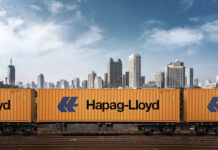



The launch of Gemini Cooperation marked more than another reshuffling of container shipping alliances. By combining deep-sea services with an integrated network of regional shuttles and feeder connections, Maersk and Hapag-Lloyd have introduced a different operating model that could reshape how global liner networks are managed.
Gemini officially began operations in February 2025 following the end of the decade-long 2M partnership between Maersk and MSC. At the same time, Hapag-Lloyd left THE Alliance, while its former partners, HMM, Ocean Network Express (ONE) and Yang Ming, formed the Premier Alliance. MSC, meanwhile, chose to continue operating independently.
Gemini is more than another alliance reshuffle. According to the DynaLiners Trades Review 2026, Maersk and Hapag-Lloyd expanded the traditional alliance model by making relay and feeder services an integral part of the network. Previously, those services mainly supported deep-sea operations.

How Gemini Cooperation differs from traditional alliances
Gemini’s mainline network covers the Europe–Far East, Transpacific, Transatlantic, Europe–Middle East/Indian Subcontinent and Far East–Middle East/Indian Subcontinent trades.
Dedicated regional shuttles and feeder operations support these deep-sea services across Europe, the Middle East, the Far East and the Gulf of Mexico. The network is centred on selected hub ports linked to terminals affiliated with at least one of the two partners.
The report describes this level of integration as unique among today’s major alliances. Gemini is the first large-scale partnership to make relay-and-feeder operations a structural element of its network. Traditional alliances rely much more heavily on direct port calls.
Between Ocean Alliance and Premier Alliance
During the first half of 2026, Gemini deployed approximately 275 vessels with a combined capacity of around 3.5 million TEU. Maersk supplied the majority of both ships and capacity.
By comparison, the Ocean Alliance remained the largest cooperative network. It operated around 350 vessels with approximately 5 million TEU of deployed capacity. The Premier Alliance deployed around 220 vessels with 2.75 million TEU.
While Gemini is smaller than Ocean Alliance in overall deployed capacity, its defining characteristic is not its size. It is its operating philosophy.
Why Maersk chose a different path
The launch of Gemini followed the conclusion of the 2M partnership, which had linked Maersk and MSC since 2015. Early in 2023, Maersk confirmed that the agreement would not continue beyond its original ten-year term, bringing 2M to an end in January 2025.
MSC responded by pursuing an independent strategy. Thanks to its scale, the carrier can operate its own global network without relying on an alliance. The report notes that MSC is the only container shipping company with sufficient capacity to effectively function as its own alliance.
Maersk took a different route. Instead of replacing 2M with another traditional partnership, it joined Hapag-Lloyd to build a network centred on hub connectivity and coordinated regional distribution.
Hapag-Lloyd’s strategic shift
Joining Gemini also marked a major strategic change for Hapag-Lloyd.
The German carrier left THE Alliance after nearly seven years, despite the agreement having been extended until 2030. Hapag-Lloyd exercised its option to withdraw before partnering with Maersk. The remaining members, HMM, ONE and Yang Ming, continued under the newly established Premier Alliance.
The decision reflects Hapag-Lloyd’s choice to pursue a different operating model rather than continue within the previous alliance framework.
Success will depend on execution
The hub-and-spoke structure offers several potential advantages. Concentrating mainline services at major hubs can simplify vessel rotations, improve asset utilisation and strengthen connections between long-haul and regional services.
However, the model also depends on close operational coordination. Delays at key hubs or disruptions affecting transfer points can quickly ripple across connected services.
That challenge comes at a time when global liner shipping continues to face significant operational uncertainty. The report highlights tariff-driven trade shifts, geopolitical tensions, industrial action and congestion as major disruptions during 2025. It also describes 2025 as the most stressful year recorded by the World Bank’s Global Supply Chain Stress Index.
Gemini’s performance will therefore depend not only on vessel deployment but also on how effectively its integrated network maintains reliable cargo flows through increasingly unpredictable supply chains.
A new direction for liner shipping
Gemini is not the largest alliance operating today, nor does it attempt to replicate MSC’s standalone strategy.
Instead, Maersk and Hapag-Lloyd are betting that a more integrated network, built around coordinated hubs, regional shuttles and feeder services, can deliver a stronger operating model for global container shipping.
Whether that approach becomes the blueprint for future alliances will depend on its ability to combine efficiency with reliability. If successful, Gemini could influence how the next generation of liner partnerships is designed.