

MSC strengthened its position as the world’s largest container shipping company in 2025, widening the gap over rival Maersk through another year of aggressive fleet expansion that outpaced every other major carrier.
According to the DynaLiners Trades Review 2026, MSC ended the year operating 971 containerships with a total fleet capacity of 7.136 million TEU, having added approximately 832,000 TEU and 92 vessels during the year. The Swiss carrier also became the first liner operator to surpass 900 ships and later crossed the 7 million TEU fleet milestone following the delivery of MSC Salerno.
The scale of MSC’s expansion is particularly striking. The carrier’s additional capacity alone would have been large enough to rank as approximately the world’s ninth-largest container shipping company, illustrating the unprecedented pace at which it continues to grow.
The gap with Maersk continues to widen
MSC’s leadership is no longer simply a matter of holding first place.
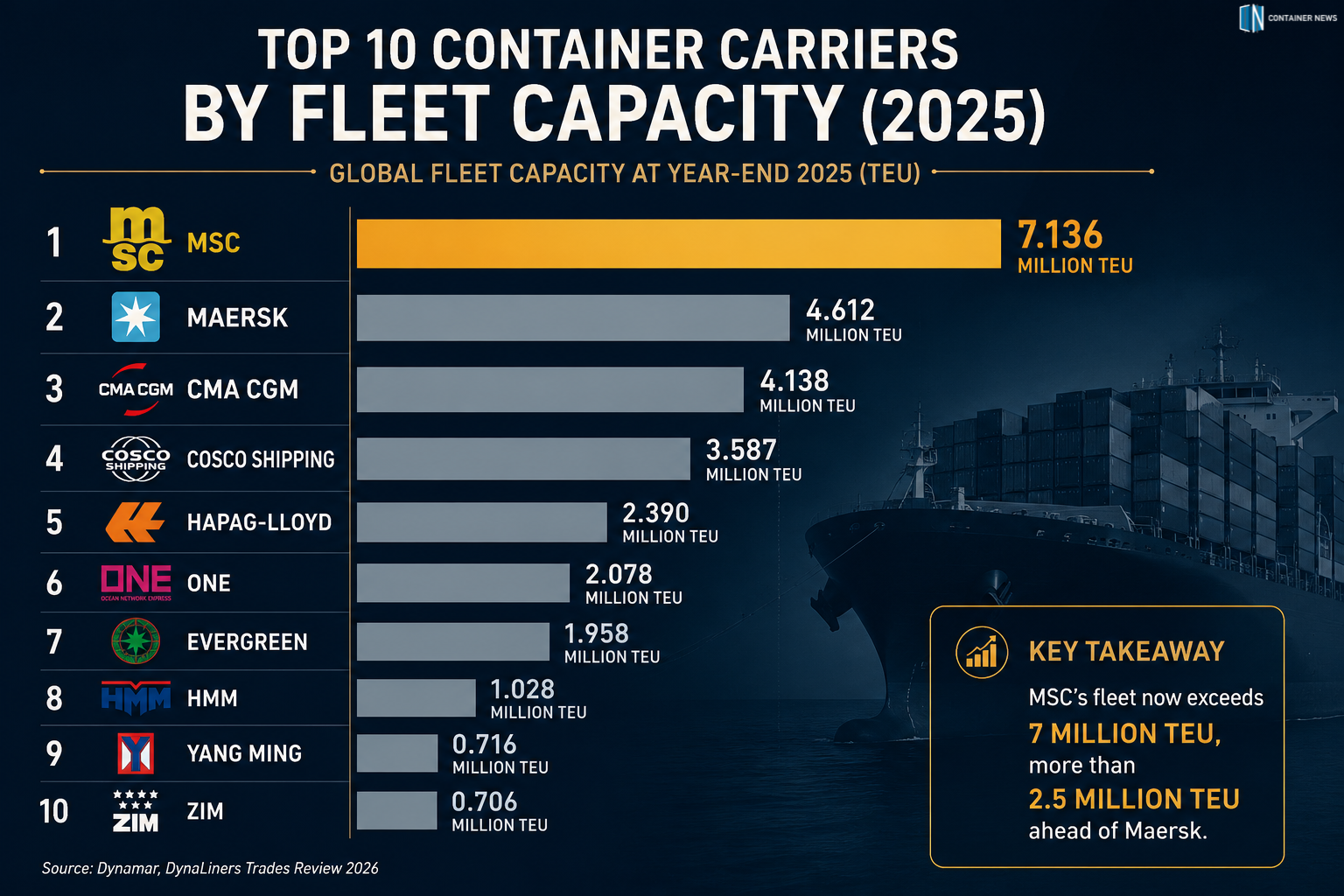
At the end of 2025, MSC’s operated fleet stood at 7.136 million TEU, compared with 4.612 million TEU for second-ranked Maersk, a difference of more than 2.5 million TEU. While MSC expanded fleet capacity by 13.2% during the year, Maersk recorded growth of 4.5%, highlighting the increasingly different pace at which the two companies are expanding.
The widening gap reflects MSC’s continued strategy of combining large-scale newbuilding deliveries with an active second-hand acquisition programme, enabling the carrier to increase capacity far more rapidly than its closest competitors.
Competition remains strong behind the market leader
Although MSC continues to pull away, the rest of the top tier also expanded during 2025.
Maersk retained second place with 4.612 million TEU, followed by CMA CGM at 4.138 million TEU and COSCO Shipping with 3.587 million TEU. All four carriers recorded fleet growth during the year, reinforcing their dominant position within the global liner market.
Further down the ranking, Hapag-Lloyd increased its fleet capacity to 2.390 million TEU, while Ocean Network Express (ONE) reached 2.078 million TEU. Evergreen continued to expand beyond 1.95 million TEU, strengthening its position among the world’s largest carriers.
HMM posts one of the fastest expansion rates
Among the leading carriers, HMM delivered one of the year’s strongest growth performances.
The South Korean carrier expanded its fleet by 27 vessels and approximately 243,000 TEU, becoming the eighth container shipping company to exceed 1 million TEU of fleet capacity. By year-end, HMM operated 97 ships with a total capacity of 1.027 million TEU.
The milestone underlines HMM’s steady recovery and continued investment following several years of fleet renewal and strategic expansion.
Not every carrier expanded
While most leading operators increased capacity, ZIM moved in the opposite direction.
The Israeli carrier’s fleet capacity declined by 9.6%, falling from 780,200 TEU to 705,500 TEU, making it the only major carrier among the top group to record negative fleet growth during the year.
Elsewhere, PIL recorded the fastest percentage growth among the leading operators, expanding capacity by 15.5%, while Evergreen grew by 11.4%, underlining that fleet expansion remained widespread across the industry rather than being limited to MSC alone.
Market concentration remains remarkably stable
Despite the varying growth rates among individual carriers, the overall market structure changed little.
The world’s ten largest container shipping companies controlled approximately 28.3 million TEU of fleet capacity at the end of 2025, representing 84% of global liner capacity. Including the next ten carriers raises the share to 91%, illustrating the high level of concentration that has characterised the sector for several years.
Although competition among the leading carriers remains intense, the rankings suggest that the gap between MSC and its closest competitors continues to widen while the broader balance of market concentration remains largely unchanged.
Looking ahead
The latest rankings highlight two parallel trends shaping the container shipping industry.
On one hand, the world’s largest carriers continue to invest heavily in fleet expansion despite growing concerns over future overcapacity. On the other, market leadership is becoming increasingly concentrated around a handful of global operators capable of financing large-scale fleet renewal and strategic acquisitions.
For MSC, 2025 marked another milestone in an expansion strategy that has transformed the company from the world’s second-largest carrier just a few years ago into an operator with a lead measured not in thousands, but in millions of TEU. Whether competitors can narrow that gap in the coming years will depend not only on newbuilding programmes but also on broader market conditions, consolidation and the industry’s ability to absorb the significant capacity still scheduled for delivery.