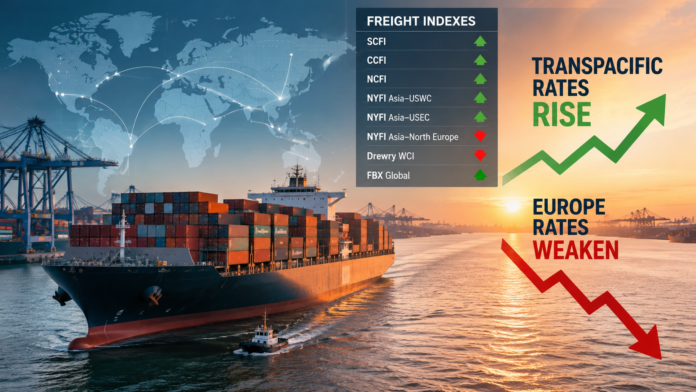
Container freight markets showed contrasting regional trends in the latest readings, with several indicators pointing to stronger Transpacific rates while Europe and the Mediterranean faced broader downward pressure.
China’s main export freight indexes also moved higher overall, reinforcing a relatively firm headline picture despite significant differences between individual trade lanes.
Chinese export indexes move higher
The Shanghai Containerized Freight Index (SCFI) increased approximately 2.9% to 3,509.54 points on 28 August.
The broader China Containerized Freight Index (CCFI) also moved higher, gaining 0.7% to 1,833.99 points.
However, individual trades showed different trends. The CCFI’s US East Coast component increased 1.9% and Europe gained 1.3%, while the Mediterranean declined 4.3% and the US West Coast edged 0.2% lower.
The Ningbo Containerized Freight Index (NCFI) reinforced the positive headline picture, rising 1.9% to 2,607.4 points. Rates increased across 14 of the 21 routes monitored by the index.
NYFI points to stronger Transpacific rates
The NYSHEX Freight Index (NYFI) showed gains on both major Asia-US trades in its 28 August readings.
Asia-US West Coast increased approximately 5.4% to 6,299.85 from 5,978.77, while Asia-US East Coast rose around 4.0% to 8,232.85 from 7,915.03.
Asia-North Europe moved in the opposite direction, declining approximately 2.2% to 4,232.85.
The Transatlantic market was mixed. Westbound rates declined 3.46% to 2,567.28, while eastbound rates increased 5.44% to 1,168.84.
NYFI is based on actual shipped container transactions, providing a transaction-based view of freight-rate movements across its covered trades.
WCI declines as European routes soften
Drewry’s World Container Index (WCI) decreased 1% to US$4,473 per 40-foot container in its 27 August assessment.
Shanghai-New York rates declined 2% to US$9,333 per 40-foot container, while Shanghai-Los Angeles remained stable at US$6,818.
The decline was also visible on European trades. Shanghai-Rotterdam fell 3% to US$4,287, while Shanghai-Genoa decreased 2% to US$4,866.
Drewry said lower rates on the Transpacific and Asia-Europe trades drove the overall decline.
FBX global index rises
The Freightos Baltic Index (FBX) Global Container Freight Index moved in the opposite direction to the WCI.
The weekly FBX increased 1% to US$3,590 per 40-foot container in its 28 August reading.
The increase supports the relatively firm headline picture seen across several of the latest global and Chinese freight benchmarks.
What the freight indexes are telling us
Taken together, the latest readings point to a freight market increasingly shaped by individual trade conditions rather than a single global direction.
The Chinese export market remained firm at composite level. SCFI rose approximately 2.9%, CCFI gained 0.7% and NCFI increased 1.9%. The global FBX also moved 1% higher.
The Transpacific showed relative strength, particularly in the NYFI data. Both Asia-US West Coast and Asia-US East Coast rates increased. However, Drewry offered a more cautious signal, with Shanghai-New York declining and Shanghai-Los Angeles remaining stable.
Europe and the Mediterranean showed more consistent signs of weakness. NYFI’s Asia-North Europe reading declined, while Drewry reported lower rates from Shanghai to both Rotterdam and Genoa. The CCFI Mediterranean component also moved sharply lower.
The indexes use different methodologies, data sources and reporting schedules, so their absolute values are not directly comparable. Their combined direction, however, suggests firmer overall export conditions from China, relative strength on parts of the Transpacific and increasing pressure on European trades.
What to watch next
Europe will be a key market to monitor in the next index updates. Further declines across several benchmarks would strengthen evidence of sustained downward pressure.
The Transpacific will also remain in focus. NYFI showed clear gains, while Drewry provided a softer signal. Capacity adjustments and demand developments will help determine whether the recent rate strength can continue into September.