
The Northern Sea Route’s 2026 season set volume records and launched the first scheduled Arctic container service. The corridor’s structure Russian gate, Chinese operators, energy cargo did not change.
This content is locked
Select a CN Premium Subscription Package To Unlock The Content!
By the end of September, the Northern Sea Route had logged 104 confirmed transit voyages, already above the 103 recorded across the whole of 2025.
Transit cargo reached an estimated 3.7 million tonnes, 15% more than last year, and the Centre for High North Logistics expects the season to approach 150 transits and 4.5 million tonnes.
The numbers confirm momentum but not transformation: the season grew along lines the corridor’s structure already permitted.
Twenty-two eastbound tanker voyages carried about 2.1 million tonnes, mostly crude loaded at Murmansk, Primorsk and Ust-Luga. That is Baltic oil leaving a sea where boardings, inspections and drone strikes have raised enforcement risk, and travelling east through waters Russia administers alone.
Bulk carriers added 1.1 million tonnes, while 27 westbound bulk voyages repositioned tonnage toward the Baltic. Crude and bulk together account for roughly 86% of transit cargo.
The NSR remains an energy and bulk artery, not a substitute for Suez.
Nor has the gate moved. Rosatom issued every permit for the season and manages the route in 28 sections; each newcomer, from South Korea’s Panstar Acro to the Chinese container operators, entered by Russian approval.
External pull is stronger than the series’ base case assumed, with the Gulf war disrupting southern energy flows, but that pull feeds a corridor whose access terms Moscow alone sets.
Weather also helped: favourable late-season ice postponed, rather than removed, the ceiling that icebreaker capacity and short navigation windows impose.
Containers are where the season broke new ground.
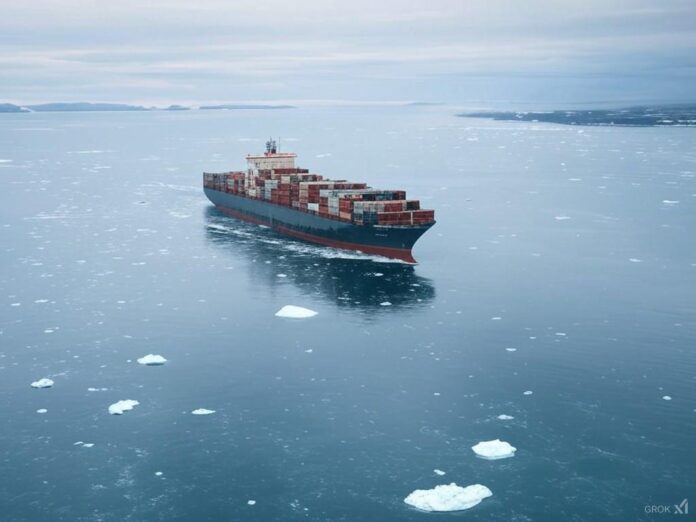
Sea Legend completed all eight weekly sailings of its China–Europe Arctic Express, moving more than 14,000 TEU of export cargo on seven ice-strengthened ships.
International Asia–Europe container transits rose from one in 2025 to four by end-September, with vessels reaching the United Kingdom from Korea and China.
After demonstration voyages in 2023–24 and trials in 2025, 2026 produced the first seasonal liner product: fixed departures, dedicated tonnage and a published transit time.
“The split runs through carriers and capital, not through cargo and ports.”
The product’s character matters more than its novelty. It is Chinese-operated, seasonal, small-ship the largest vessel carries 4,890 TEU and driven by westbound exports. Its entire season moved less than one ultra-large container ship carries on a single voyage.
It competes with rail and air-sea for time-sensitive peak-season cargo, not with Suez mainline services. And it leaves Western carriers absent without excluding Western economies: no European or American line runs a comparable service, yet the boxes land at Felixstowe and other Western ports.
The next stage points to density rather than scale.
NewNew Shipping targets 1.2 million tonnes for 2027 with two sailings a month and has signalled interest in investing in Russian Arctic ports, while Murmansk is building a partnership with it.
That would extend Chinese institutionalisation into Russian physical infrastructure and deepen the lock-in that keeps Western carriers out.
The binding constraints remain: Sea Legend ended departures early on ice forecasts even in a favourable year, and the service relies on repurposed, ageing tonnage rather than purpose-built ice-class ships.
The likely outcome is a durable Chinese seasonal niche commercially marginal, strategically significant, and operating at Russia’s discretion.