
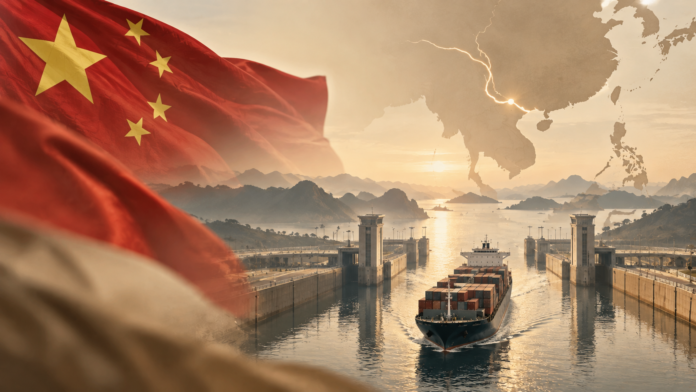
China has officially opened the Pinglu Canal, establishing a new direct waterway between the country’s southwestern inland regions and the Beibu Gulf and creating a shorter maritime gateway towards Southeast Asia.
The 134.2-kilometre canal officially opened to navigation on 16 September, following construction that began in August 2022.
The project, which represents an investment of approximately RMB72.7 billion (US$10.2 billion), runs from Pingtangjiangkou in Hengzhou, Nanning, through Luwu in Qinzhou before following the Qinjiang River into the Beibu Gulf.
Built to China’s Class I inland waterway standard, the Pinglu Canal can accommodate vessels of up to 5,000 tonnes.
First shipping routes begin operations
The opening was accompanied by the launch of two direct river-sea shipping services.
According to Xinhua, the Nanning Port–Can Tho Port route connecting China with Vietnam and the Nanning Port–Yangpu Port domestic route began their maiden voyages on the same day as the canal’s opening.
The international service provides a new direct connection between inland Guangxi and Vietnam through the Beibu Gulf, strengthening the canal’s role as a transport corridor between southwestern China and ASEAN markets.
The canal connects the Xijiang River system with the Beibu Gulf, allowing cargo from Nanning and other inland areas to reach the sea without following the considerably longer existing inland route towards ports further east.
Chinese authorities estimate that cargo from southwestern China moving through the Pinglu Canal can shorten its inland journey to the sea by more than 560 kilometres compared with routing via Guangzhou.
Canal begins one-year trial operation
While the canal has officially opened, the initial operating phase will run under a one-year trial arrangement.
The Guangxi Pinglu Canal Management Center confirmed that trial navigation runs from 16 September 2026 until 15 September 2027.
The operational section extends from Pingtangjiangkou in the Xijin reservoir area of Hengzhou to the starting point of Qinzhou Port’s eastern navigation channel, covering the canal’s full 134.2-kilometre length.
Different sections have navigable water depths of between 6.3 and 6.5 metres, while channel widths range from 80 to 100 metres.
Three major navigation complexes — Madao, Qishi and Qingnian — control the substantial elevation difference along the route.
Each is equipped with Class I double-line ship locks capable of handling 5,000-tonne vessels. The lock chambers have effective dimensions of 300 metres in length, 34 metres in width and eight metres in minimum sill depth.
The Guangxi authorities have confirmed that the locks are designed to operate 24 hours a day, except during suspensions caused by maintenance, extreme weather, flooding, emergencies or other navigation restrictions.
River-sea operations target lower logistics costs
One of the most significant operational changes associated with the canal is the development of direct river-sea shipping.
Authorities have established arrangements allowing qualifying inland vessels to reach seaport terminals at Qinzhou, reducing the need for additional cargo transfers between inland and coastal vessels.
Ahead of the opening, Guangxi authorities said more than 570 vessels had already met the requirements to navigate the canal, while 681 captains and navigation officers had obtained the necessary Pinglu Canal route endorsements.
Infrastructure on both the river and sea sides has also been adapted to support river-sea intermodal operations, with authorities estimating available handling capacity of more than 16 million tonnes.
Guangxi expects the new corridor to reduce overall logistics costs for relevant cargo flows by between 18% and 30%, while annual transport cost savings could exceed RMB5 billion.
New gateway for southwestern China
The Pinglu Canal forms a core component of China’s New International Land-Sea Trade Corridor, which connects inland western and southwestern provinces with ports along the Beibu Gulf.
Its opening potentially expands the hinterland of Beibu Gulf ports by providing another transport option for cargo originating in Guangxi and neighbouring inland regions.
The canal is also designed to complement existing rail and road connections rather than operate solely as an inland waterway. Guangxi is developing river-sea transfers and rail-water-sea intermodal services to attract cargo from a wider hinterland.
Authorities have been working with shipping companies, logistics providers and cargo owners across Guangxi as well as inland regions including Yunnan and Chongqing ahead of the opening.
The new waterway is expected to strengthen connections between southwestern China, the Beibu Gulf and ASEAN markets, with the launch of the Nanning–Can Tho service providing the first direct international route accompanying the canal’s entry into operation.