

Successful breakbulk shipments require coordination between the cargo owner, shipbroker, vessel operator, port and lifting specialists.
A useful starting point is to distinguish container liner shipping from the physical use of containers as cargo units. Containers may form part of a mixed breakbulk shipment and be carried aboard a multipurpose or general cargo vessel alongside machinery, steel structures and other non-containerised units. In such cases, the container remains a practical method of packing and protecting smaller components, while the voyage itself is planned and performed as a breakbulk or multipurpose shipment.
Container shipping has transformed global trade by making cargo movements more standardised, predictable and scalable. For a large proportion of manufactured goods, the container remains the most practical transport unit. It protects the cargo, simplifies handling and allows shippers to use established liner services across an extensive network of ports.
However, not every shipment can be adapted to container dimensions or handled safely within the limits of standard container equipment. Industrial machinery, transformers, pressure vessels, construction equipment, steel structures and prefabricated components may exceed the permissible dimensions or weight of standard containers and flat racks. In such cases, attempting to force the cargo into a container-based solution can introduce unnecessary risk, cost and operational complexity.
The correct question is not simply whether a cargo can physically be placed on container equipment. Cargo owners must determine whether container transport remains the most practical solution after considering dimensions, weight distribution, lifting requirements, route restrictions and the total cost of handling.
When a Standard Container Liner Solution Is No Longer Sufficient
Standard dry containers offer fixed internal dimensions and relatively straightforward handling. Open-top containers and flat racks extend these possibilities, particularly for cargo that is over-height or over-width. Nevertheless, they also have operational limitations.
The cargo must remain within the structural capacity of the equipment. Its weight must be distributed correctly, and suitable securing points must be available. Significant over-width or over-height can restrict where the unit may be positioned on a container vessel and may result in the loss of several adjacent container slots. This lost capacity is normally reflected in the freight calculation.
Terminal equipment and inland infrastructure create additional restrictions. Even when an ocean carrier accepts the cargo, the flat rack must still be transported to the loading terminal and from the discharge terminal to its final destination. Road permits, bridge clearances, turning radii, overhead cables and terminal lifting capacity may determine whether the proposed container solution is genuinely workable.
Container liner schedules can also be less flexible when specialised lifting arrangements or extended port operations are required. A vessel operating within a tightly controlled schedule may not be able to accommodate cargo that requires non-standard handling, additional crane time or complex coordination between several contractors.
Why Breakbulk Becomes the Better Alternative

Breakbulk transport allows cargo dimensions, lifting arrangements and stowage positions to be assessed individually.
Breakbulk and multipurpose shipping allow cargo units of different types and dimensions to be loaded directly aboard a conventional general cargo, multipurpose or heavy-lift vessel. A mixed shipment may also include containers carried alongside machinery, steel structures and other non-containerised units.
This approach offers greater flexibility in the dimensions and weights that can be accepted. Cargo can be loaded into the vessel’s holds, secured on deck or positioned in another suitable location according to its technical characteristics and the vessel’s capabilities.
For cargo owners, the principal advantage is not simply additional space. A breakbulk fixture can be planned around the cargo itself. Vessel selection may consider hatch dimensions, deck strength, crane capacity, lifting outreach, hold configuration, permissible deck loading and the suitability of the loading and discharge ports.
Professional breakbulk cargo chartering therefore begins with a technical assessment rather than an immediate freight quotation. The shipbroker must understand the cargo, the intended route and the proposed operating method before approaching suitable vessel owners.
The Information Required Before Vessel Selection
Accurate cargo information is essential. A basic description such as “one industrial unit” or “heavy machinery” is not sufficient to identify a vessel or calculate realistic freight.
The shipbroker will normally require:
- Exact dimensions and gross weight of every cargo unit
- Technical drawings and photographs
- The location and capacity of lifting points
- The centre of gravity, where relevant
- Supporting and securing requirements
- Details of transport saddles, frames or packing
- The cargo readiness date
- The proposed loading and discharge ports
- Any restrictions affecting the handling method
Small differences can materially change the available vessel options. A unit weighing 80 tonnes may be suitable for a geared multipurpose vessel, while a heavier unit could require two cranes operating in tandem or external shore cranes. Similarly, cargo that fits inside the hold at its widest point may still be unable to pass through the hatch opening.
The dimensions must therefore be checked against the complete loading path, not merely the available space at the final stowage position.
Vessel Cranes and Shore Cranes
The choice between vessel cranes and shore-based lifting equipment can determine which ports and ships are suitable.
A vessel equipped with sufficiently powerful cranes may provide greater flexibility, particularly at ports where shore equipment is unavailable or limited. Some multipurpose vessels can combine two cranes for a tandem lift, but the total safe working load is not the only consideration. Crane outreach, cargo position alongside the vessel, lifting-point geometry and the coordination of both cranes must also be assessed.
Shore cranes may offer greater lifting capacity, but their availability must be confirmed for the intended dates. The berth must also provide sufficient working space and ground-bearing capacity for the crane and its supporting equipment.
Neither method should be assumed before the lifting plan has been reviewed. A freight quotation based on an incorrect lifting assumption may appear attractive initially but become unusable once the actual operational requirements are established.
Port Suitability Can Decide the Entire Transport Plan

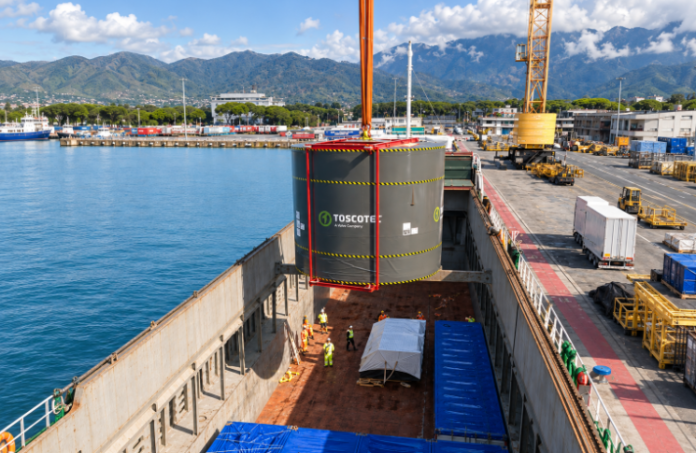
Container being loaded aboard a general cargo vessel as part of a mixed breakbulk shipment.
A suitable vessel does not automatically make the voyage feasible. Both ports must be capable of receiving the vessel and handling the cargo safely.
The assessment may include berth length, permissible draught, water depth, air-draught restrictions, tidal limitations and the availability of pilots and tugs. For heavy or oversized cargo, the terminal must also confirm crane access, quay strength, storage arrangements and the route between the berth and the port gate.
At the discharge port, the cargo may require direct delivery from the vessel to a heavy-haul trailer. If the trailer cannot be positioned alongside the vessel or cannot leave the terminal because of infrastructure restrictions, the proposed discharge operation may need to be redesigned.
These matters should be investigated before the vessel is fixed. Discovering a port restriction after signing the charter party can result in delays, additional equipment costs or even a change of port.
Freight Must Be Evaluated as a Total Transport Cost
Breakbulk freight is often compared directly with the ocean freight quoted for a flat rack or other specialised container equipment. This comparison can be misleading if it excludes the complete transport chain.
A container-based quotation may include additional costs for special equipment, slot losses, lifting, securing, terminal handling, storage and repositioning. Oversized equipment may also face restrictions at transhipment hubs, increasing the risk of delay.
A breakbulk voyage may involve a higher basic ocean freight but reduce the number of handling stages. Depending on the cargo and route, direct shipment between suitable ports can avoid transhipment and allow loading and discharge arrangements to be organised specifically for the cargo.
The lowest quoted ocean freight is not necessarily the lowest final transport cost. Cargo owners should compare the complete operational scope, including all handling, securing, port and inland transport requirements.
Contractual Details Matter
Once a suitable vessel and operating plan have been identified, the charter-party terms must reflect the actual responsibilities of each party.
The agreement should clearly address who provides cranes, lifting gear, spreader beams, stevedores, lashing materials and engineering support. It should also define the agreed loading and discharge rates, laytime provisions, weather interruptions and the consequences of delays.
Cargo readiness is especially important. A vessel fixed for a specific laycan cannot wait indefinitely because manufacturing, customs formalities or inland delivery have not been completed. If the cargo misses the agreed window, the commercial consequences may include detention, demurrage or cancellation.
Technical and contractual planning must therefore proceed together. A workable lifting plan does not protect the cargo owner from poorly defined commercial obligations.
Making the Decision Early
The choice between container equipment and a breakbulk vessel should be made early in the planning process. Waiting until a container carrier rejects the cargo can leave insufficient time to identify suitable vessels, verify ports and negotiate realistic charter terms.
Early assessment allows the shipbroker to compare alternatives and determine whether the shipment should move as out-of-gauge containerised cargo, conventional breakbulk cargo or project cargo requiring a specialised heavy-lift solution.
Container shipping remains the natural choice for standardised cargo. But when dimensions, weight or handling requirements exceed its practical limits, a breakbulk vessel should not be treated merely as a last-minute alternative. With proper technical information and coordinated planning, it can provide the safer, more direct and commercially reliable solution.
Author Biography

Konstantin Kalnyi, CEO & Founder of Kiev Shipping Ltd and an international shipbroker with more than 25 years of experience.
Konstantin Kalnyi is the CEO and Founder of Kiev Shipping Ltd and an international shipbroker with more than 25 years of experience. Since 2000, he has arranged more than 350 voyages involving dry bulk, breakbulk, project and general cargoes.