
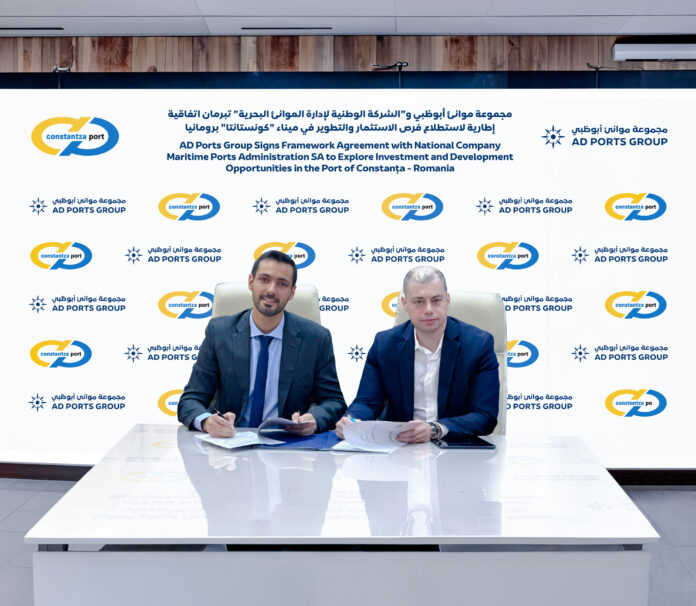
AD Ports Group has signed a framework agreement with the National Company Maritime Ports Administration SA to explore investment and development opportunities at the Port of Constanța in Romania.
The agreement focuses on potential collaboration in port expansion, digital transformation, and sustainability initiatives. These include greenfield and brownfield development, deployment of digital solutions, renewable energy adoption, waste management improvements, and emissions reduction projects.
Strategic Black Sea gateway
The Port of Constanța is the largest port on the Black Sea and one of Europe’s key maritime hubs. It handled around 88 million tonnes of cargo and about 1 million TEUs in 2025.
The port sits at the mouth of the Danube–Black Sea Canal. It connects maritime routes with inland transport networks across Eastern and Central Europe. It also handles major grain and agricultural cargo flows from the region.
Supporting the Middle Corridor strategy
AD Ports Group said the agreement supports its broader strategy along the “Middle Corridor,” which links China to Europe through Central Asia.
Captain Mohamed Juma Al Shamisi, Managing Director and Group CEO of AD Ports Group, said the partnership provides a platform to strengthen cooperation with one of the Black Sea’s most strategic ports. He said the group aims to expand connectivity and support sustainable trade growth.
Expanding regional footprint
AD Ports Group has increased its investments across Central Asia and Pakistan in recent years to strengthen the Middle Corridor route.
Recent projects include a logistics joint venture in Kazakhstan, a new intermodal hub in Georgia, and a grain terminal development at Kuryk Port. The group has also expanded tanker operations across the Caspian Sea and launched a logistics joint venture in Tajikistan.
The company said these investments aim to improve trade connectivity between Asia and Europe while supporting more efficient and lower-impact transport routes.