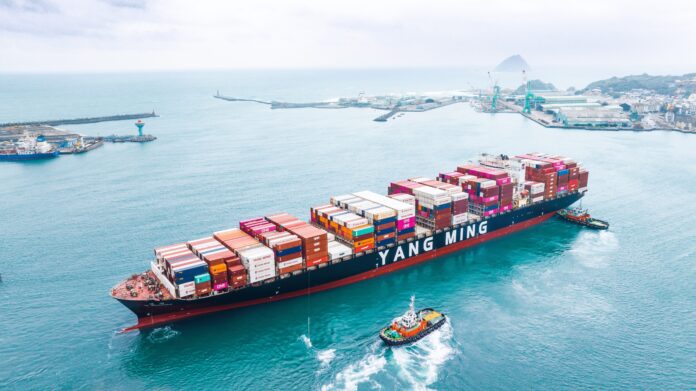
Yang Ming Marine Transport Corporation reported an after-tax net profit of NT$7.17 billion (US$230 million) for the first half of 2026, as stronger second-quarter market conditions helped improve the Taiwanese carrier’s performance.
The company generated consolidated revenue of NT$84.58 billion (US$2.68 billion) during the six-month period, while earnings per share (EPS) reached NT$2.05.
Q2 performance improves
Yang Ming reported a stronger performance in the second quarter, supported by higher freight rates and an earlier start to the traditional peak season.
Consolidated revenue reached NT$45.92 billion (US$1.45 billion) in Q2 2026. After-tax net profit stood at NT$5.73 billion (US$180 million), while EPS reached NT$1.64.
According to the carrier, changes in tariff policies and rising energy costs encouraged import booking demand on the Asia-Europe and Transpacific trades. This brought some peak-season cargo forward and supported freight rates.
Based on the reported figures, approximately 80% of Yang Ming’s first-half net profit was generated during the second quarter.
Supply growth expected to outpace demand
Yang Ming highlighted the continuing imbalance between container shipping supply and demand.
Citing July forecasts from Alphaliner and Drewry, the carrier said global container fleet capacity is expected to increase by 4.2% and 4.4%, respectively.
By comparison, the two organisations forecast container demand growth of 2.5% and 2.1%.
Meanwhile, Yang Ming cited the International Monetary Fund’s July 2026 outlook, which projects global GDP growth of 3% this year.
Peak season and congestion in focus
Looking ahead to the third quarter, Yang Ming said the Asia-Europe and Transpacific trades have entered their traditional peak season. Cargo demand is expected to provide support to market conditions.
However, the carrier pointed to congestion at Shanghai and European ports as another factor affecting operations. Congestion worsened during the second quarter due to adverse weather, short-term cargo surges and terminal bottlenecks.
Yang Ming said geopolitical developments and tariff policies will continue to influence cargo flows and capacity deployment.
The company plans to monitor demand and adjust fleet deployment and sailing schedules when necessary. It will also strengthen port contingency management and cost controls as it seeks to improve schedule reliability and operational competitiveness.