
U.S. containerized imports increased in May as seasonal demand returned after April’s slowdown, according to Descartes’ June Global Shipping Report.
Imports reached 2.43 million TEUs in May, up 6.6% from April and 11.5% compared with May 2025. The increase follows the seasonal pattern typically seen in May, when import volumes usually exceed April levels.
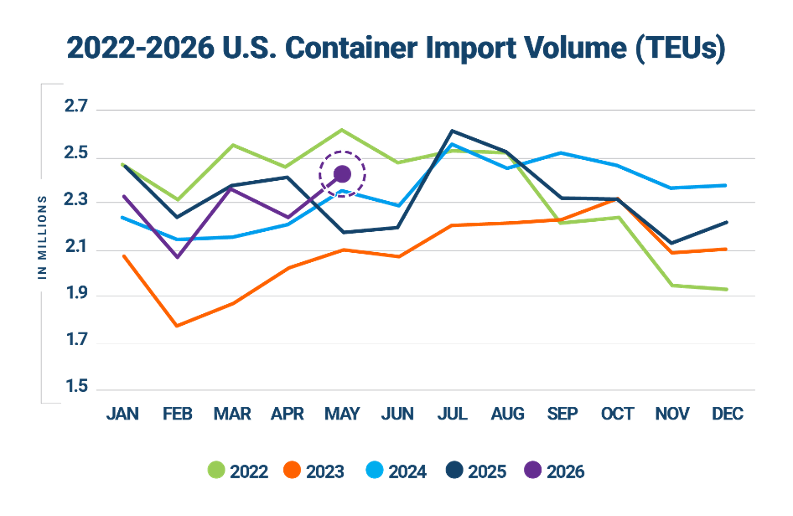
Despite the monthly recovery, total imports for the first five months of 2026 were down 1.9% compared with the same period last year. However, volumes remained 16.4% higher than pre-pandemic 2019 levels.
China led the growth among major sourcing countries.
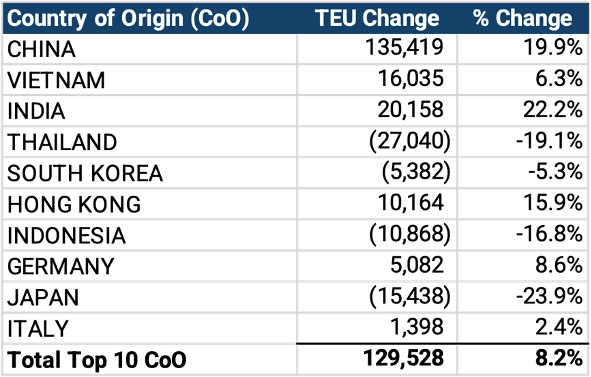
Imports from China rose 19.9% month-on-month to add 135,419 TEUs. Volumes were also 28.1% higher than in May 2025. India recorded a 22.2% increase, adding 20,158 TEUs, while imports from Vietnam rose 6.3% and Hong Kong volumes increased 15.9%. Germany and Italy also posted gains.
Several sourcing markets recorded declines.
Imports from Thailand fell 19.1%, while Japan dropped 23.9%. Indonesia and South Korea also posted lower volumes compared with April.
The top 10 U.S. ports remained stable and handled 89.9% of total imports in May, the highest share recorded since March 2023.
Source: Descartes Datamyne™
Descartes said the global trade environment remains volatile. Ongoing instability in the Strait of Hormuz and the Red Sea, new U.S. tariff proposals and continued U.S.-China trade tensions are creating additional uncertainty for supply chains.
“Despite a highly uncertain global trade environment, U.S. containerized import trends remain positive over the first five months of the year,” said Jackson Wood, Director of Industry Strategy at Descartes.
“As numerous major factors add complexity to sourcing and cost-management decisions, including ongoing Strait of Hormuz disruptions, new U.S. tariff proposals and U.S.-China trade tensions, U.S. importers remain focused on managing supply chain risk and resiliency to stay agile amid persistent volatility.”
Descartes said the latest data highlights a shipping environment shaped by volatility, shifting sourcing strategies and rising costs.