
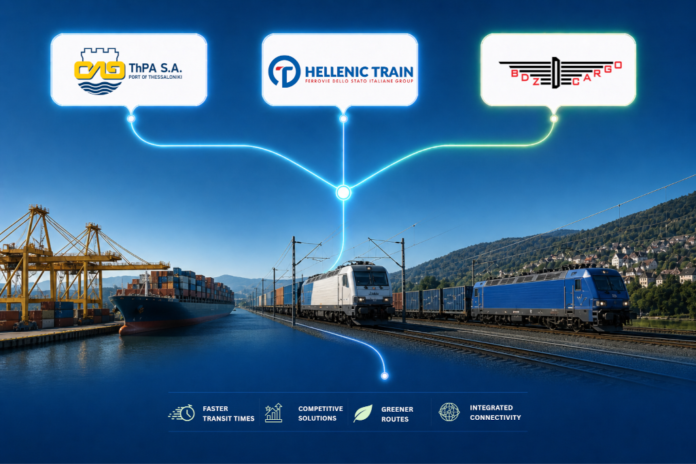
Thessaloniki Port Authority has signed a Memorandum of Understanding with Hellenic Train and Bulgarian State Railways on April 7, 2026, establishing a trilateral cooperation framework aimed at strengthening intermodal transport and expanding supply chain connectivity across Southeastern Europe.
The agreement creates the foundation for a rail cargo corridor centred on the Port of Thessaloniki, extending connectivity into Bulgaria, the Balkans and Central European markets.
The cooperation focuses on four principal objectives: upgrading Thessaloniki’s rail connectivity, developing competitive cargo transport services, reducing transit times and logistics costs, and promoting sustainable transport through rail infrastructure improvement.
The MoU is designed to ensure coordinated action among the three parties, accelerating critical infrastructure projects and optimising services to facilitate trade and regional development.
The agreement comes at a strategically significant moment for the Port of Thessaloniki, which is currently implementing its most ambitious investment programme in its modern history, with the Pier 6 expansion as the flagship project.
Upon completion, the expansion will more than double the container terminal’s capacity, substantially strengthening the port’s competitiveness and positioning it as a major transit hub for Southeast Europe.
Realising the full potential of this expanded capacity requires commensurate improvements in rail connectivity, making the MoU a natural complement to the port’s physical infrastructure investment.
Dr Ioannis Tsaras, CEO of ThPA S.A., described the port’s geographical position at the heart of Southeast Europe as a strategic asset for establishing Thessaloniki as a reliable provider of intermodal transport solutions for the Balkans.
He framed the MoU as a catalyst for coordinated infrastructure development that will benefit Northern Greece, the national economy and the broader regional supply chain, while contributing to a meaningful shift toward more environmentally sustainable transport modes.