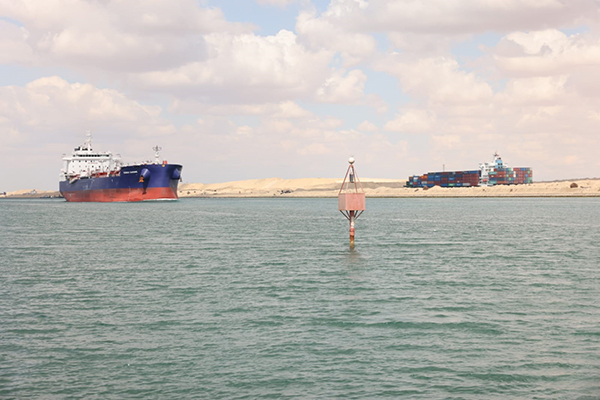
Container ship traffic through the Suez Canal has reached its highest level since the Red Sea disruptions began, with weekly transiting capacity exceeding half of pre-crisis levels for the first time.
According to BIMCO, citing Clarksons Research data, an average of 753,000 TEU of container ship capacity passed through the canal each week during the first two weeks of October 2026. This compares with 1.46 million TEU during the same period in 2023.
The increase follows a series of decisions by major container shipping lines to restore services through the Red Sea after nearly three years of widespread diversions around the Cape of Good Hope.
Shipping lines accelerate return to Suez
BIMCO reported that 36% of container ship capacity travelling via either the Suez Canal or the Cape of Good Hope used the canal during the first two weeks of October.
This represents a sharp increase from the average of 8% recorded between 2024 and mid-2026. However, it remains below the 80% share seen before the Red Sea attacks.
The recovery began gathering pace in July 2026, when Maersk and Hapag-Lloyd announced the return of their AE15/SE3 Asia–Mediterranean service to the canal.
Further changes followed across the Gemini Cooperation network, while members of the Ocean Alliance and Premier Alliance, along with MSC, also announced revised routings.
In total, shipping lines have announced routing changes affecting 16 services since early July.
The recovery has also become more balanced between sailing directions. During the third quarter, northbound capacity was equivalent to 75% of southbound capacity. That figure increased to 81% in early October.
Capacity recovery could affect freight markets
The return to shorter routes could have significant implications for global container shipping capacity.
BIMCO estimates that diversions around the Cape of Good Hope increased global demand for container ship capacity by approximately 10%. As more vessels return to the Suez Canal, that additional demand is beginning to decline.
However, congestion at Asian ports could delay the full impact on vessel availability and the balance between supply and demand.
“We estimate that rerouting away from the Suez Canal increased global container ship demand by about 10%. That increase is now reducing quickly,” said Niels Rasmussen, Chief Shipping Analyst at BIMCO.
Despite the recent recovery, Suez Canal traffic remains below pre-disruption levels, indicating that the return to normal container shipping routes is still incomplete.