

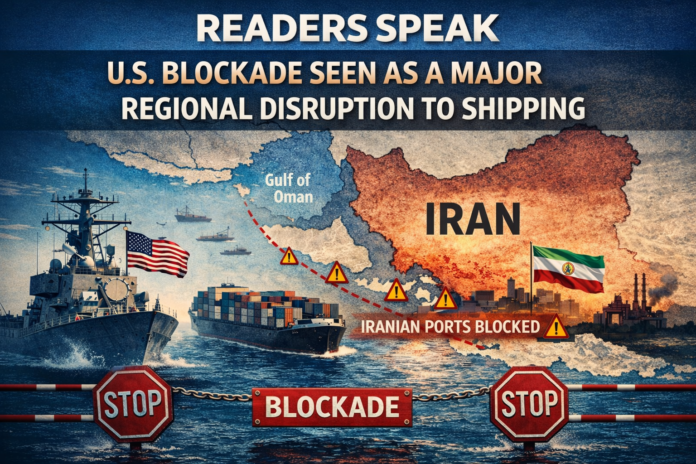

Strong consensus on regional impact
The U.S. blockade targeting Iranian ports is already shaping industry expectations. In the latest Readers Speak poll, participants were asked how this measure could affect container shipping.
The outcome is clear: most readers expect a major disruption at the regional level, rather than a contained or negligible effect.
This reflects the immediate operational impact of restrictions on vessels linked to Iranian ports, even as transit through the Strait of Hormuz remains technically open for non-Iranian traffic.
Regional disruption emerges as the dominant view
The leading opinion among respondents is that the blockade will significantly affect trade flows within the Gulf region.
This aligns with early market observations. Shipping activity linked to Iran has already been heavily constrained, with vessels turning back or avoiding affected ports altogether .
For many readers, this suggests a meaningful disruption to regional supply chains, even if global container networks remain largely intact.
Limited global impact remains a secondary expectation
A smaller but notable group believes the broader impact on global container shipping will be limited.
This view is supported by the structure of container trade. Only a small share of global container capacity typically transits this corridor, meaning the direct global effect may remain contained .
However, even those expecting limited impact acknowledge that uncertainty and risk premiums could still influence operations.
Selective impact on Iran-linked cargo seen as minimal view
Only a small share of respondents sees the blockade as affecting primarily Iran-linked cargo flows.
While the measure is targeted by design, readers appear to believe its consequences extend beyond purely Iranian trade, particularly through indirect effects on routing decisions, insurance, and regional logistics.
Uncertainty remains part of the outlook
A portion of respondents still considers it too early to fully assess the impact.
This reflects the fluid nature of the situation, as enforcement evolves and geopolitical tensions continue to shift. Reports of limited vessel movement and ongoing military positioning highlight how quickly conditions can change .
A targeted action with wider implications
The results suggest that while the blockade is selective in scope, the industry expects broader regional consequences.
Rather than a global shock, readers anticipate:
- localized disruption
- continued volatility
- and cautious operational decision-making.
Conclusion
Readers send a clear signal:
the U.S. blockade of Iranian ports is expected to disrupt regional shipping significantly, even if global container trade remains relatively resilient.
As enforcement continues and tensions evolve, the focus will remain on how targeted actions translate into wider operational impacts across the Middle East.