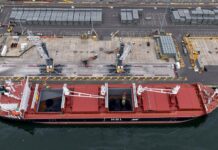

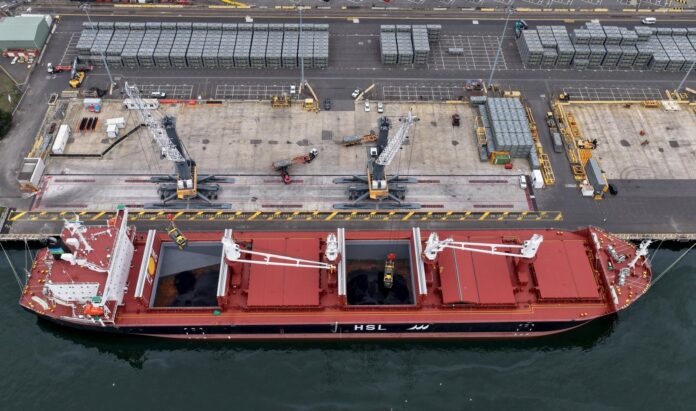
Port of Melbourne, in partnership with Qube, Australian Amalgamated Terminals and the Victorian Government, has activated a new rail-enabled export pathway for critical minerals at Appleton Dock, marking a significant step in building Victoria’s critical minerals industry to support renewable energy, advanced manufacturing and emerging technologies.
The first rail shipment was loaded onto a vessel that departed the port on September 28, 2026.
The initiative involves targeted infrastructure upgrades at Appleton Dock, including enhanced wharf infrastructure, improved rail interfaces, streamlined bulk handling processes and specialised equipment to support efficient train-to-ship commodity transfer.
The upgrades transition the facility from a general cargo operation to a multimodal logistics hub capable of handling dry bulk commodities with strong integration between rail and maritime operations.
The rail-connected infrastructure enables transport of critical minerals from the Qube Ultima Intermodal Terminal to the port for vessel loading and onward delivery for processing.
Port of Melbourne CEO Saul Cannon described the upgrades as unlocking new export capacity while improving supply chain performance, noting that the port has invested more than AU$ 1 billion in infrastructure since 2016 with a further AU$ 1.5 billion planned by 2030.
AAT Managing Director Pat Smith characterised the Appleton Dock transformation as heralding a new era for the facility as an intermodal terminal capable of facilitating both general cargo and bulk exports.
Qube Bulk Director Todd Emmert highlighted the company’s heavy haulage, rail infrastructure expertise and proprietary Rotabox technology as delivering an integrated pit-to-port solution supporting jobs and economic growth across the supply chain.
Victorian Minister for Ports and Freight Melissa Horne described the rail freight investments as ensuring critical minerals can meet the demand created by the renewable energy transition, complementing the government’s broader rail line investments through Korong Vale to Manangatang.