
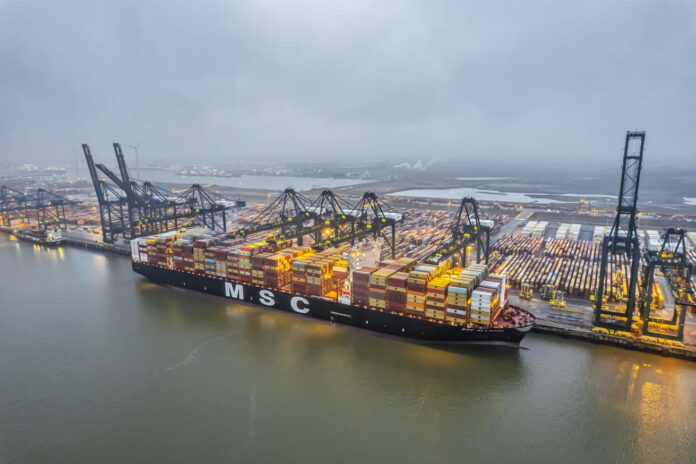
Mediterranean Shipping Company (MSC) has announced an update to its Emergency Fuel Surcharge (EFS), citing ongoing disruption in the global fuel market linked to recent developments in the Middle East.
The situation has led to a sharp increase in marine fuel prices and disrupted the normal distribution of bunker supply, reducing availability at key sourcing locations and increasing operating costs across the carrier’s network.
The revised surcharge will apply to cargo moving between Northern Europe, Scanbaltic, the West Mediterranean, Adriatic, Red Sea and East Africa, covering both directions of trade.
The updated EFS will be effective from April 16, 2026 (based on bill of lading date) until April 30, 2026.
For shipments from the Red Sea, rates are set at USD 135 per TEU for dry cargo and USD 205 for reefer cargo to Northern Europe, and USD 200 (dry) and USD 300 (reefer) to Scanbaltic. Cargo moving to the West Mediterranean and Adriatic will be charged USD 100 (dry) and USD 155 (reefer), while shipments to East Africa will incur USD 145 (dry) and USD 220 (reefer).
From East Africa, the surcharge to Northern Europe is set at USD 255 (dry) and USD 385 (reefer), rising to USD 320 (dry) and USD 480 (reefer) for Scanbaltic destinations. Shipments to the West Mediterranean and Adriatic will be charged USD 235 (dry) and USD 355 (reefer), while cargo moving to the Red Sea will be subject to USD 145 (dry) and USD 220 (reefer).
In the opposite direction, shipments from Northern Europe, including the UK, to the Red Sea will be charged USD 135 (dry) and USD 205 (reefer), and USD 255 (dry) and USD 385 (reefer) to East Africa. From Scanbaltic, rates are set at USD 200 (dry) and USD 300 (reefer) to the Red Sea, and USD 320 (dry) and USD 475 (reefer) to East Africa.
The update reflects MSC’s response to continued volatility in fuel markets, as carriers adjust surcharges to manage rising bunker costs and operational challenges.