
Maersk has issued guidance for customers shipping waste and scrap cargo, with particular attention to batteries and electronic waste.
The carrier said cargo intended for disposal, recycling or recovery must be booked as waste. Shipments must comply with the Basel Convention, the OECD Decision and waste legislation in every country along the route. This includes transit and transshipment countries.
Maersk highlighted the fire risk posed by batteries. A single cell that short-circuits inside a sealed container can cause a fire that crews may struggle to reach or extinguish at sea.
The carrier also clarified that waste classification, hazardous waste classification and dangerous goods classification involve three separate assessments. Cargo that does not qualify as hazardous waste may still require regulatory consent or a dangerous goods declaration.
Mixed loose batteries with unprotected terminals present a particular concern. When the battery chemistry cannot be confirmed, customers should assume that lithium cells are present unless documentation identifies every cell.
E-waste
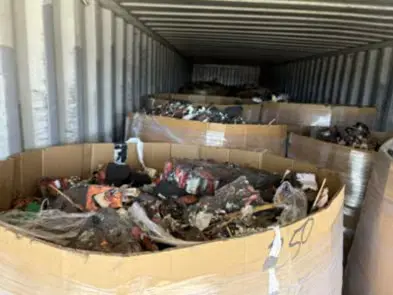
E-waste includes discarded equipment that depends on electricity, along with its components and shredded fractions.
Maersk said all e-waste shipments require prior written consent from every country involved in the route, including transit and transshipment countries.
Customers should book e-waste without batteries under commodity code 001415. E-waste containing batteries and batteries shipped for recycling or disposal must use code 002808. These shipments must be declared as dangerous goods without exemption.
Metal scrap
Clean and uncontaminated metal scrap generally falls under the green-listed category. However, shippers must verify its status.
Metal scrap loads may contain batteries, electronic equipment, capacitors, oils or sealed vessels. Even a small amount of contamination can determine the classification of the entire container.
Customers should book metal scrap without e-waste under code 002313. Batteries and electronic items must be declared separately, with batteries booked under code 002808.
Plastic scrap and waste paper
Only sorted, single-polymer plastic that is almost free from contamination qualifies as green-listed waste. Mixed, contaminated and halogenated plastics require prior consent.
Maersk also noted that exports of plastic waste from the European Union to non-OECD countries will be prohibited from 21 November 2026. Customers should book plastic waste and scrap under code 002811.
Waste paper generally qualifies as green-listed. However, shipments remain subject to national contamination limits, inspections and licensing requirements. Loads containing plastic film, laminates or general waste fall outside the waste paper classification.
The applicable booking code for waste paper is 002803.
Customer declaration requirements
Maersk asked customers to confirm container contents with their shipper in writing before booking. The declaring party remains responsible for the accuracy of the declaration.
Customers must book waste under the appropriate commodity code and provide any required consent or permit references. They must also declare batteries and cells separately as dangerous goods, using the correct UN number and IMDG packing requirements.