Euroseas reported a net income attributable to controlling shareholders of $33.2 million in the second quarter of 2026, supported by strong containership charter rates and limited drydocking expenses.
The Athens-based containership owner generated net revenues of $56.5 million during the quarter, compared with $57.2 million in the same period of 2025. Adjusted EBITDA increased to $40.1 million from $39.3 million a year earlier.
Euroseas operated an average fleet of 21 vessels during the quarter, which earned an average time charter equivalent (TCE) rate of $30,306 per day. This compares with 22 vessels and an average TCE rate of $29,420 per day in the second quarter of 2025.
Net income attributable to controlling shareholders increased from $29.9 million in Q2 2025 to $33.2 million in Q2 2026. Basic earnings per share rose to $4.77 from $4.32 a year earlier.
Charter market remains strong
Euroseas Chairman and CEO Aristides Pittas said the first two quarters of 2026 were among the company’s most profitable consecutive quarters in the past 15 years.
“We are pleased to report financial results for the second quarter of 2026 at par with the first quarter of the year, making these two of our most profitable consecutive quarters of the last fifteen years,” said Aristides Pittas, Chairman and CEO of Euroseas.
According to Pittas, solid charter contracts at profitable rates and low drydocking expenses supported the company’s performance.
The containership charter market remained strong during the second quarter, with high daily rates continuing through July and into early August. Demand from charterers also remained strong, including for older vessels.
Euroseas has secured charter coverage of more than 95% for the remainder of 2026. Coverage stands at 81% for 2027 and 47% for 2028.
The company also highlighted the continuing impact of geopolitical disruption on container shipping. Red Sea diversions have increased TEU-mile demand and the number of vessels required, supporting tonnage demand and charter rates.
However, Euroseas warned that an eventual normalization of these inefficiencies, combined with the existing containership orderbook, could create medium-term challenges.
The company noted that the orderbook is concentrated mainly in larger vessel sizes. By contrast, the feeder and intermediate segments in which Euroseas operates have smaller orderbooks and older fleet profiles. As a result, the company expects limited fleet growth or potentially fleet contraction in these segments.
Euroseas expands newbuilding programme to 12 vessels
Euroseas has expanded its newbuilding programme to 12 feeder and intermediate containerships, with deliveries scheduled between the third quarter of 2027 and the first quarter of 2029.
The programme comprises four intermediate vessels of 4,484 TEUs, four 2,798-TEU feeders and four 1,781-TEU feeders. Combined capacity amounts to 36,252 TEUs.
The first four vessels have already secured charter employment at $35,500 per day. Once all 12 newbuildings are delivered, Euroseas expects to operate one of the youngest feeder and intermediate containership fleets in the industry.
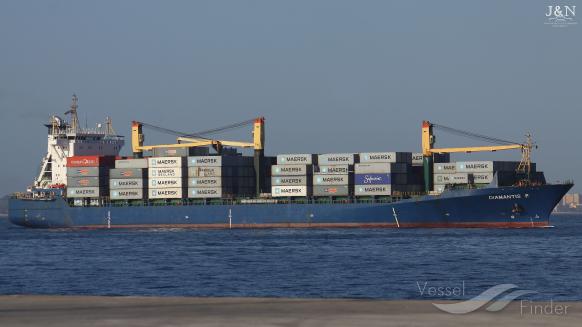
Euroseas currently operates 21 containerships with a combined capacity of 61,144 TEUs.
H1 adjusted EBITDA reaches $81 million
For the first half of 2026, Euroseas reported net revenues of $112.3 million, down 1.1% from $113.6 million in the corresponding period of 2025.
Net income attributable to controlling shareholders reached $65.7 million, compared with $66.8 million a year earlier. Meanwhile, adjusted EBITDA increased to $81 million from $76.4 million.
The average TCE rate increased to $30,330 per vessel per day during the first half, compared with $28,468 in H1 2025.
The company also declared a quarterly dividend of $0.80 per share for Q2 2026. The dividend is expected to be paid on or around 16 September to shareholders of record on 9 September.