
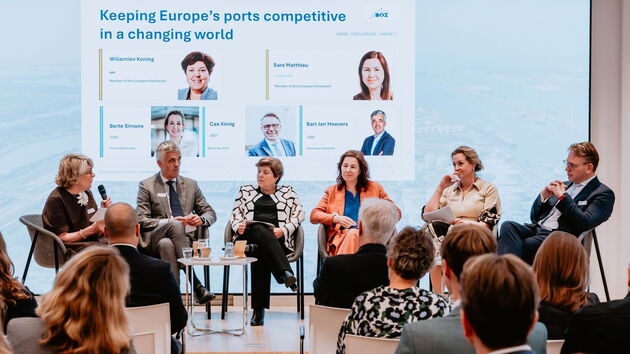
Five Dutch seaports have called on European policymakers to swiftly translate the European Ports Strategy into concrete, practical and adequately funded measures, presenting their joint position paper Full Steam Ahead during a meeting in Brussels on September 29.
The port authorities of Amsterdam, Groningen Seaports, Moerdijk, Rotterdam and North Sea Port, cooperating within the Dutch Seaports Association, engaged in discussions with Members of the European Parliament Sérgio Gonçalves, Willemien Koning and Sara Matthieu, with Gonçalves serving as the Parliament’s rapporteur on the file.
The discussion was moderated by Isabelle Ryckbost, Secretary General of the European Sea Ports Organisation.
The European Commission presented the European Ports Strategy in March 2026, explicitly recognising ports as strategic hubs for trade, industry, energy and security and addressing port competitiveness, the energy transition, security and access to financing.
The Dutch ports welcomed this recognition as an important step forward while emphasising that the next challenge lies in clarifying how Europe’s ambitions will be implemented in practice.
Their joint position paper identifies three key priorities.
The first is investment certainty, enabling ports to commit to sustainable energy and infrastructure projects.
The second is clear agreements on strategic port infrastructure, including recognition and definition of responsibilities for dual-use infrastructure that serves both civilian and military purposes, covering quays, rail connections, waterways, energy facilities and storage locations essential for economic activity and military mobility alike.
The third is stronger cross-border cooperation across European port communities, governments and businesses.
The five ports intend to remain closely engaged with European policymakers, other ports and the business community as the European Parliament develops its position on the strategy in the coming period.