
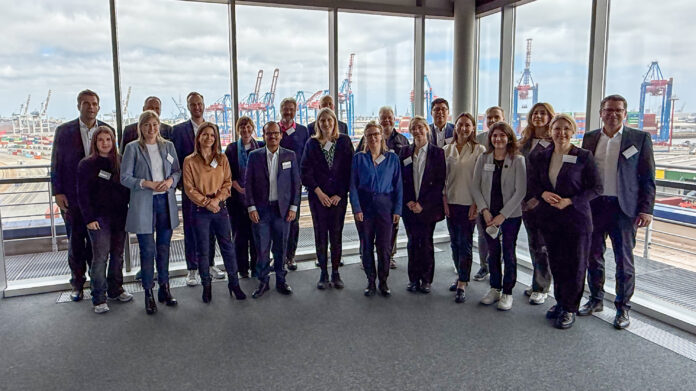
Senior representatives from ports, industry and policy institutions across the Baltic Sea Region gathered in Hamburg on April 23 for a workshop examining the energy transition and decarbonisation of transport, held at the HHLA Container Terminal Tollerort.
The event was organised by the Free and Hanseatic City of Hamburg’s Senate Chancellery Baltic Sea Strategy Point in cooperation with Port of Hamburg Marketing, with support from HHLA.
The workshop was framed around the strategic importance of ports as geopolitical assets and key enablers of Europe’s energy transition, with the specific objective of strengthening the visibility of port-related decarbonisation challenges within the EU Strategy for the Baltic Sea Region and fostering cross-sectoral collaboration across energy, transport, safety and shipping policy areas.
Participants identified long-term regulatory stability as a central prerequisite for driving decarbonisation and the energy transition at scale, alongside the need for stronger regional collaboration to share best practices, coordinate investments and develop replicable solutions.
The importance of sustained funding for pilot projects and continued efficiency improvements were also emphasised as enabling conditions for progress.
Discussion sessions addressed a broad range of topics including the current status of decarbonisation efforts at the Port of Hamburg, covering onshore power supply, alternative fuel infrastructure and green shipping corridor development.
Emerging marine fuels including methanol, ammonia and hydrogen were examined from a market perspective, alongside the role of hinterland rail connectivity in enabling sustainable logistics chains and the operational challenges facing the shipping industry in reducing emissions.
Digital coordination and cross-sector collaboration were highlighted as tools for unlocking further efficiency gains.
A key conclusion from the workshop was that sustainable port and logistics infrastructure is essential to building a resilient Baltic Sea Region, and that progress requires coordinated action across institutional, commercial and operational levels.