
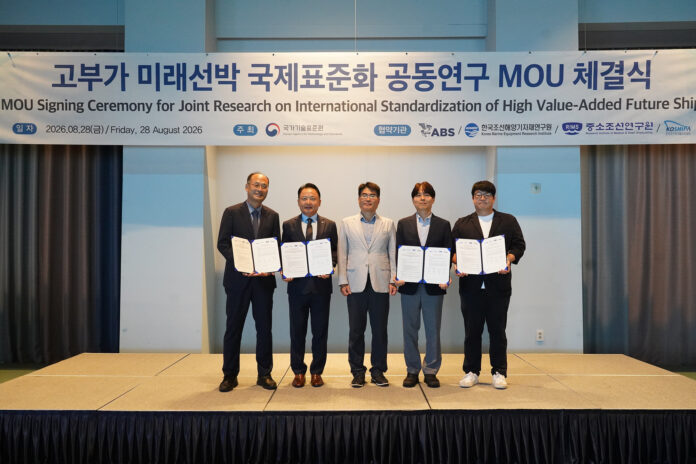
ABS has signed a five-year agreement with three South Korean maritime organisations to develop international standards for smart ships, advanced shipyards and future maritime technologies.
The classification society will work with the Korea Marine Equipment Research Institute (KOMERI), Korean Offshore & Shipbuilding Association (KOSHIPA) and Research Institute of Medium & Small Shipbuilding (RIMS).
Focus on hydrogen ships and digital production
The cooperation will focus on global standards for vessels and shipyards using digital technologies, smart manufacturing and advanced maritime systems.
ABS is already supporting preliminary standards in two areas.
The first covers digital production and traceability requirements for additively manufactured ship components.
The second focuses on vent mast design for hydrogen-fueled vessels.
“Next-generation shipbuilding is advancing rapidly, and the international standards that govern smart ships, smart shipyards and advanced manufacturing are still taking shape,” said Patrick Ryan, ABS Senior Vice President and Chief Technology Officer.
Five-year cooperation framework
The new agreement builds on earlier cooperation between ABS and the Korean Agency for Technology and Standards (KATS).
That initiative focuses on the international standardisation of smart ship and shipyard technologies.
According to ABS, the latest agreement also forms part of Korea’s efforts to strengthen its position in the development of high-value-added vessels.
The cooperation comes as new technologies move from research and development towards commercial maritime applications.
ABS said it will continue supporting the development of standards and safety frameworks for emerging maritime technologies.