
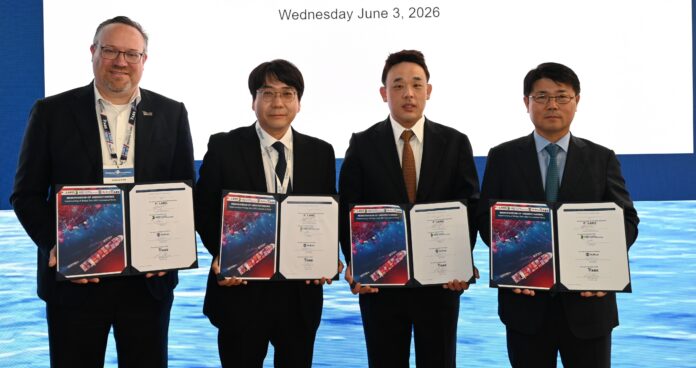
ABS, Polaris Shipping, HD Hyundai Heavy Industries (HHI) and AVIKUS have signed a concept study agreement to develop a Conditional Unmanned Bridge for very large ore carriers (VLOCs).
The project will evaluate autonomous bridge operations on one of Polaris Shipping’s 325,000 dwt VLOCs during deep-sea voyages.
The concept allows the bridge to operate without crew only under specific low-risk conditions, such as open-ocean passages. It does not involve fully autonomous voyages.
The study aligns with the International Maritime Organization’s forthcoming Maritime Autonomous Surface Ships (MASS) Code and aims to support the commercial deployment of autonomous navigation.
Patrick Ryan, Senior Vice President and Chief Technology Officer at ABS, said the study will focus on the interaction between autonomous systems, vessel design and safety.
“ABS will apply a structured safety evaluation, drawing on hazard identification, functional safety analysis and alignment with the IMO MASS Code.”
Polaris Shipping will analyze operational data from its VLOC fleet to define the boundary between human and automated operations.
AVIKUS will develop the autonomous navigation concept and technical requirements, while HHI will assess the vessel design changes needed to support unmanned bridge operations.
The four companies will jointly identify regulatory and technical gaps before publishing the study’s findings. The results will also support future ship designs and autonomous navigation systems.