
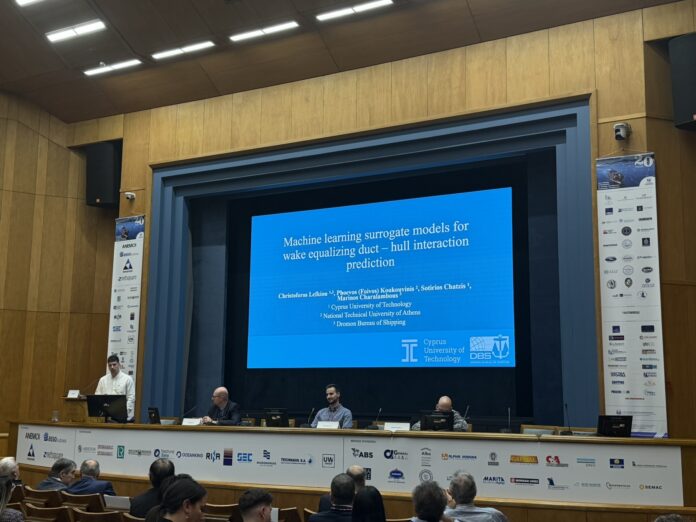
The Hellenic Institute of Marine Technology marked two decades of industry dialogue with the 20th Annual Conference of Marine Technology, held on 6 and 7 October 2026 at the Eugenides Foundation in Athens.
The anniversary conference brought together representatives from shipping companies, technology providers, classification societies, academic institutions and public authorities. Discussions examined the technologies, regulations and workforce developments shaping the future of shipping.
Container News participated in the two-day event through its Managing Director, Giannis Nikolakis, Managing Editor, Antonia Saratsopoulou, and Geopolitical Analyst, Alexandros Itimoudis.
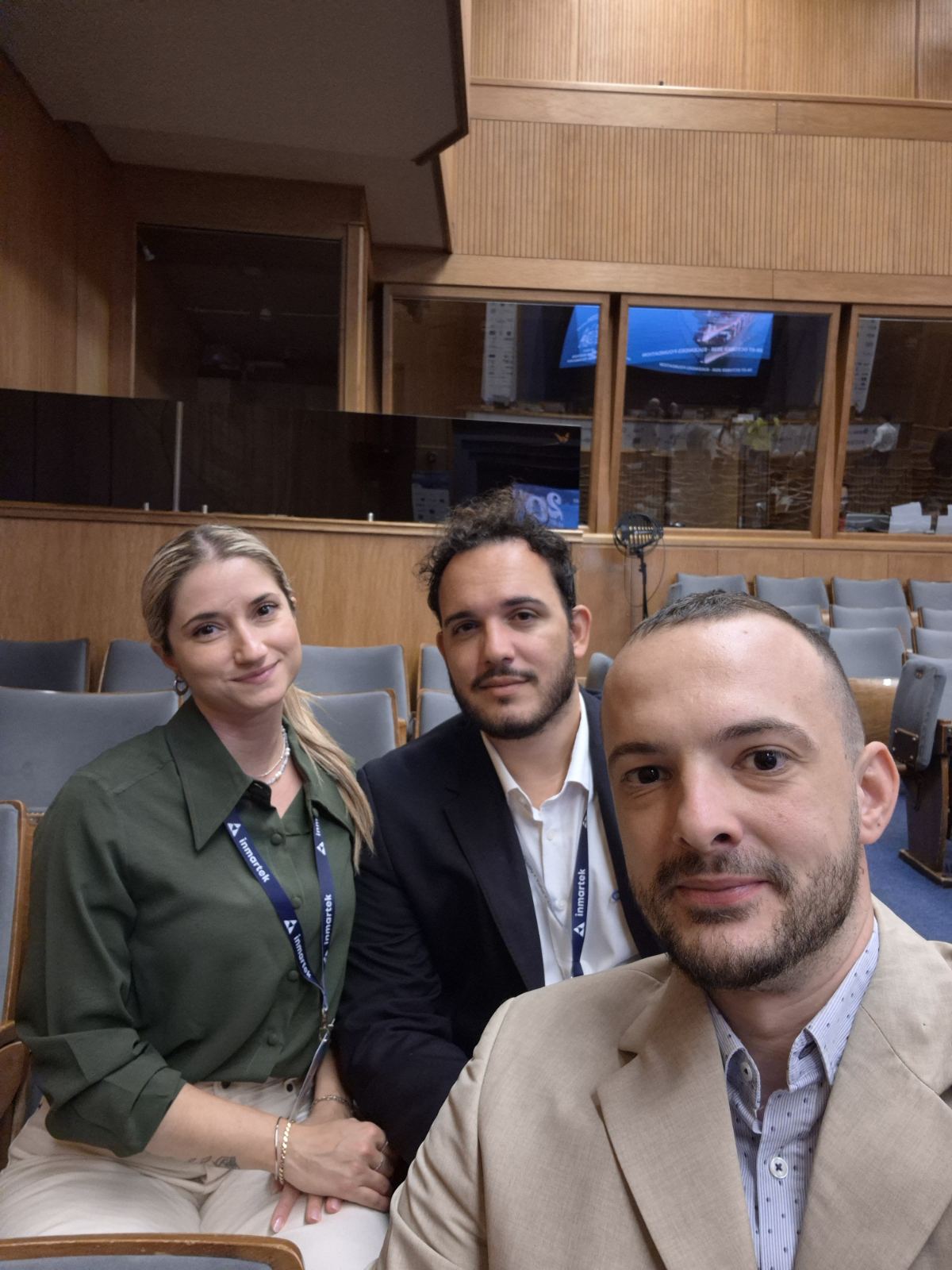
From left: Antonia Saratsopoulou, Managing Editor; Giannis Nikolakis, Managing Director; and Alexandros Itimoudis, Geopolitical Analyst of Container News, at the 20th Annual Conference of Marine Technology in Athens.
Maritime technology and geopolitical uncertainty
The conference opened with addresses from senior representatives of the Greek maritime community. Speakers included Greece’s Minister of Maritime Affairs and Insular Policy, Vassilis Kikilias, alongside representatives from the Hellenic Chamber of Shipping, the Union of Greek Shipowners, the European Shortsea Network, academic institutions and maritime associations.
The first day combined technical presentations with panel and round-table discussions. The programme addressed wind propulsion, subsea cable protection, boil-off gas compression, maritime cybersecurity, carbon credits and onboard carbon capture.
Additional presentations examined vessel safety, data quality, regulatory reporting, hull cleaning, hybrid propulsion and autonomous shipping legislation.
One panel explored how alternative fuels, safety challenges and geopolitical realities are affecting shipping. A second discussion examined market volatility and the changing maritime economy.
The day concluded with a round-table discussion on the future maritime workforce. Participants considered how the industry must adapt as vessels, technologies and operational requirements evolve faster than traditional training structures.
Annual Conference of Marine Technology highlights research
The second day of the 20th Annual Conference of Marine Technology focused strongly on scientific research and practical maritime applications.
Parallel sessions covered methanol combustion, biofuels, low-carbon marine fuels, artificial intelligence in ship finance and new antifouling coatings.
Researchers also presented studies on wind-assisted propulsion, offshore wind farms, ship emissions, autonomous vessels and hybrid marine engines.
Further sessions examined machine learning, vessel-motion modelling, health-risk monitoring, structural failure prevention and offshore vessel safety. The programme concluded with presentations on onboard carbon capture, fuel-cell performance and the challenges affecting maritime digitalisation projects.
Across both days, the conference connected academic research with commercial and operational requirements. Decarbonisation, digitalisation, safety and geopolitical risk emerged as central themes throughout the programme.
The anniversary edition also reinforced the conference’s role as a meeting point between the Greek maritime sector, international shipping stakeholders and the research community.